


A caregiver clocks in, completes a visit, and drives to the next client’s home. Three weeks later, the agency receives a denied claim.
What went wrong? The app may have worked correctly, but the visit never reached the state’s EVV aggregator. Maybe the GPS location didn’t match the client’s address. Or someone may have corrected a missed clock-out without providing a reason.
These small issues can create bigger problems for home care agencies. They can delay payments, increase administrative work, and lead to denied claims.
This is why choosing the best EVV software for home care agencies requires more than comparing features. The right system for a Minnesota personal care agency may not work for a Texas home health provider. State requirements play a major role in deciding which software an agency can use.
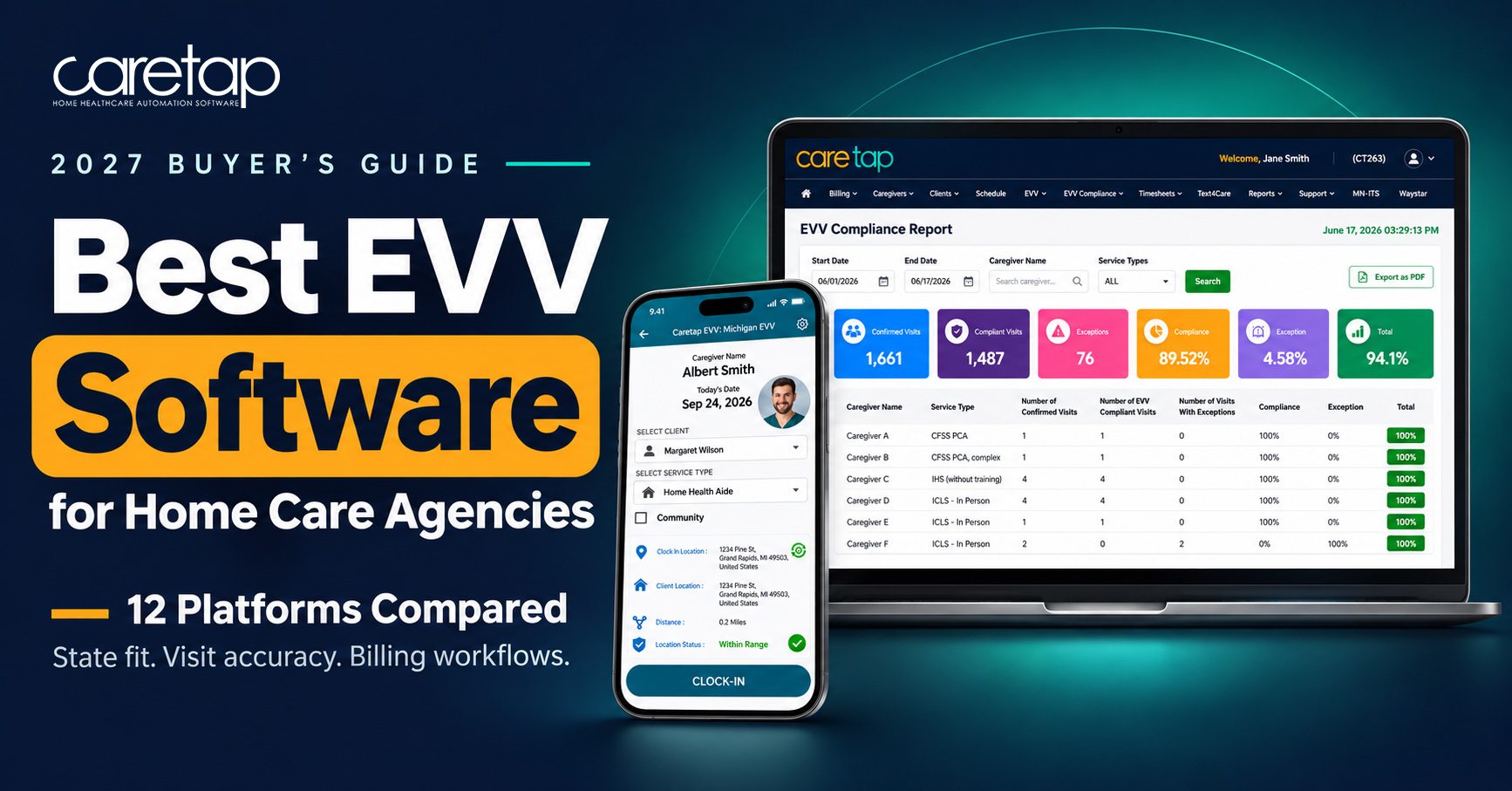
This guide compares 12 EVV systems based on what matters most to agencies: accurate visit records, state aggregator connections, billing, and payment processing.
Start by checking your state’s EVV model. In a closed-model state, agencies must use the system selected by the state or managed care plan. In open and hybrid states, agencies may choose an approved third-party system, provided it connects to the state’s aggregator and sends accurate visit records for billing and payroll.
Disclosure: Caretap publishes this guide and is one of the systems included in the comparison. Each software profile is based on information from the vendor’s public website and state Medicaid resources, checked in November 2026. We have not tested competitor products firsthand.
What Does EVV Software Need to Track?
Section 12006 of the 21st Century Cures Act requires Electronic Visit Verification (EVV) for Medicaid-funded personal care and home health services provided in the home.
To meet federal requirements, an EVV system must record six details for every visit:
- Service provided: The type of care delivered.
- Client information: The person receiving the service.
- Visit date: The date the service was provided.
- Visit location: Where the service took place.
- Caregiver information: The person providing the service.
- Visit time: The start and end times of the visit.
The EVV requirement began on January 1, 2020, for personal care services and January 1, 2023, for home health services. Some states, including Michigan, received approval to delay the home health deadline until January 1, 2024.
By 2026, simply recording these details is not enough. Agencies also need to make sure their EVV systems send accurate information that state aggregators and payers can accept.
The federal EVV requirement applies to Medicaid-funded services. Private-pay visits are not covered by this federal rule. However, managed care organization (MCO) contracts, waiver programs, and long-term care insurance providers may have their own EVV requirements.
Check Your State’s EVV Model Before Choosing Software
CMS recognizes five EVV models. For home care agencies, these models generally fall into three practical categories:
- Closed model: The state or managed care plan selects the EVV system. Agencies are generally required to use that system, which is often available at no cost.
- Open model (provider choice): Agencies can select and pay for their own EVV software. The chosen system must send visit information to the state’s aggregator or payer.
- Hybrid model (open vendor): The state provides a free EVV system, but agencies can choose an approved third-party vendor if it connects to the state’s aggregator.
EVV Software Compared at a Glance
| System | Type | Best for | Pricing |
|---|---|---|---|
| Agency software8 platforms | |||
| Caretap | Agency software | Small, mid-size, and large home care agencies in Minnesota, Illinois, Michigan, and New Jersey, including multi-program Medicaid providers | Quote-based |
| Alora | Agency software | Home health, home care, and hospice agencies | Quote-basedCapterra lists from $295/month |
| AlayaCare | Agency software | Growing and multi-branch home care agencies | Quote-basedCapterra lists from $1,000/month |
| AxisCare | Agency software | Non-medical home care and multi-state agencies | Quote-basedPriced by number of clients |
| Axxess | Agency software | Agencies running home health, home care, and hospice on one platform | Quote-based |
| CareSmartz360 | Agency software | Private duty and Medicaid home care, including multi-location agencies | Quote-basedPriced by active clients per month; Capterra lists from $10/month |
| Therap | Agency software | IDD and HCBS waiver providers | Quote-basedFree to providers in some state programs, such as North Dakota |
| Timeero | GPS time tracking with EVV | Small agencies | $12/user/monthPremium plan, which includes EVV; $10 billed annually |
| State and payer EVV systems4 systems | |||
| Sandata | State system and aggregator | Agencies in Sandata states, such as North Carolina and California | Free state version in some statesSuch as Hawaii; agency software is quote-based |
| HHAeXchange | State aggregator and agency software | Agencies in Minnesota, Michigan, New Jersey, and other HHAeXchange states | Free state portal in some statesSuch as Minnesota and Michigan; Enterprise is quote-based |
| Netsmart | State aggregator and agency software | Agencies in Netsmart states, such as Florida, Georgia, and Kentucky | Free state version in some statesSuch as Kentucky; agency software is quote-based |
| CareBridge | State/MCO aggregator | Agencies in Iowa, Wyoming, and other CareBridge MCO programs | Free for providers in its programsSuch as Iowa MCO programs |
Pricing comes from each vendor’s website, state Medicaid resources, and Capterra listings, checked November 2026. Directory prices are starting points; actual quotes depend on agency size and services. Confirm current pricing and your state’s aggregator connection with each vendor before you sign.
The 12 Best EVV Software Systems for Home Care Agencies
These platforms help agencies manage caregiver schedules, client visits, and billing while recording EVV information.
We compared them based on five important factors:
- Connection to state EVV aggregators
- Available visit verification methods
- Offline visit recording
- Billing and payroll workflows
- Pricing transparency
-
Caretap
Publisher- Type
- Agency software
- Pricing
- Quote-based
Best for: Small, mid-size, and large home care agencies in Minnesota, Illinois, Michigan, and New Jersey, including Medicaid providers managing PCA alongside programs such as EIDBI and ARMHS.
Caretap helps agencies manage caregiver visits and record EVV information through its iOS and Android apps. More than 12,000 caregivers record visits on Caretap every day.
The mobile app captures GPS location, visit dates, start and end times, and service details. If a caregiver or client does not have access to a smartphone signal, the visit can also be verified through telephony using the client’s landline.
Caregivers and clients can electronically sign timesheets during the visit. The system also provides exception reports that help agencies identify visits that need review or correction.
Once recorded, visit information syncs with scheduling, billing, and payroll. Caretap also integrates with ADP and QuickBooks, reducing the need to enter the same information into multiple systems.
For state connectivity, Minnesota DHS lists Caretap among the third-party systems integrated with HHAeXchange. Caretap also connects to HHAeXchange in Michigan through EDI and offers state-specific EVV setups for Illinois and New Jersey.
EVV is included at no cost on Caretap. The wider platform is priced by quote.
What to ask: If your agency operates outside Minnesota, Illinois, Michigan, or New Jersey, ask Caretap about aggregator support in your state.
See Caretap EVV in action
Bring your state requirements, payer information, and one real service code. We’ll show you how Caretap handles your EVV workflow.
-
Alora
- Type
- Agency software
- Pricing
- Quote-based
Best for: Home health, home care, and hospice agencies.
Alora combines GPS-based visit tracking with telephony as a backup verification method.
The platform connects with Sandata, HHAeXchange, Netsmart, and CareBridge. It can also identify visit discrepancies, such as a caregiver forgetting to clock out, before sending the records to the aggregator.
What to ask: Confirm which aggregator connections are currently active for your state and payers.
-
AlayaCare
- Type
- Agency software
- Pricing
- Quote-based
Best for: Growing and multi-branch home care agencies, especially those with caregivers working in rural areas.
AlayaCare supports offline visit recording. Caregivers can record visits without an internet connection, and the information syncs once the device reconnects.
Its EVV features also connect with other agency operations, including scheduling, documentation, payroll, and billing.
What to ask: Request a list of its active aggregator connections for every state where your agency provides services.
-
AxisCare
- Type
- Agency software
- Pricing
- Quote-based
Best for: Non-medical home care agencies that bill Medicaid across multiple states.
AxisCare allows caregivers to verify visits through its mobile app or telephony.
It works with several major aggregators, including HHAeXchange, Sandata, AuthentiCare, CareBridge, and Netsmart. This makes it a practical option for agencies that bill Medicaid in more than one state.
What to ask: Ask the vendor to demonstrate how the system identifies and handles a missed clock-out.
-
Axxess
- Type
- Agency software
- Pricing
- Quote-based
Best for: Agencies running home health, home care, and hospice on one platform.
Axxess provides EVV features such as missed-visit alerts, offline visit recording, and an Exception Center.
The Exception Center helps agencies review incorrect visit records, make corrections, and resubmit EVV information.
Axxess also publishes state-specific integration information so agencies can check its connection status.
Pay attention to the status shown for your state. If an integration is marked “Under Consideration,” it is not yet live.
What to ask: Confirm that the integration is active, not still under consideration, for your state and payer.
-
CareSmartz360
- Type
- Agency software
- Pricing
- Quote-based
Best for: Private duty and Medicaid home care agencies, including multi-location agencies.
CareSmartz360 supports GPS-based visit tracking and telephony verification.
In Iowa, the platform integrates with CareBridge, allowing agencies to send EVV information to the state’s Medicaid aggregator.
Pricing is based on the number of active clients each month, so ask how your bill changes as your census moves.
What to ask: How will your monthly cost change as your agency adds or loses clients?
-
Therap
- Type
- Agency software
- Pricing
- Quote-based; free in some state programs
Best for: Agencies serving people with intellectual and developmental disabilities (IDD) and Home and Community-Based Services (HCBS) waiver programs.
Therap combines GPS-based check-in with an offline mobile app and service documentation features.
It also plays an official role in several state programs. North Dakota contracts with Therap as its EVV vendor and offers it to providers at no cost, while Sandata serves as that state’s aggregator. Therap is the state EVV solution in South Dakota and the aggregator in Alaska.
What to ask: If your state offers Therap for free, ask which features are included at no cost and which require a paid subscription.
-
Timeero
- Type
- GPS time tracking with EVV
- Pricing
- $12/user/month for EVV
Best for: Small agencies that mainly need GPS time tracking.
Timeero offers GPS time tracking with EVV features.
EVV is only available on the Premium plan, which costs $12 per user per month, or $10 billed annually. The $6 Basic plan, limited to 10 users, does not include EVV.
One important consideration is state approval. Timeero notes that it may not be an approved EVV vendor in every state.
What to ask: Confirm whether Timeero is approved for your state and whether it connects to your required aggregator.
State-Sponsored EVV Systems and Aggregators
Some states and managed care plans select their own EVV systems or aggregators.
Agencies may need to use these systems directly, often at no cost, or connect their existing software to them.
A free state EVV system can help agencies meet compliance requirements. However, it may not include all the features needed to manage daily operations.
Without an integration between the state system and your agency software, staff may need to enter the same information twice.
Here are four major state and payer EVV systems to know.
-
Sandata
- Type
- State system and aggregator
- Pricing
- Free state version in some states
Sandata became part of HHAeXchange following its acquisition in October 2024.
It supports state EVV programs, including North Carolina and California’s CalEVV aggregator. Some states, such as Hawaii, let providers use Sandata’s state EVV system for free.
In North Carolina, caregivers can verify visits using Sandata Mobile Connect, telephony, or a fixed verification device. Agencies can buy the device for $85 or lease it for $7 per month.
What to ask: Confirm which verification methods are available under your state’s program.
-
HHAeXchange
- Type
- State aggregator and agency software
- Pricing
- Free state portal in some states
HHAeXchange serves as the state EVV aggregator in Michigan, Minnesota, New Jersey, and several other states.
In Minnesota and Michigan, providers can use a free HHAeXchange EVV portal. Agencies that need more features can pay for HHAeXchange’s enterprise platform.
Caregivers can record visits through its mobile app or Interactive Voice Response (IVR), a phone-based verification system.
Third-party EVV software can connect to HHAeXchange through API or EDI integrations.
This allows agencies to use their preferred agency management software while sending visit information to the state aggregator.
What to ask: If you use the free portal, ask what it does not include, such as billing or payroll tools.
-
Netsmart
- Type
- State aggregator and agency software
- Pricing
- Free state version in some states
Netsmart acquired Tellus in 2020 and serves as the state EVV aggregator in Florida, Georgia, Kentucky, and Nebraska. Kentucky offers it to providers as a free state-sponsored system.
It provides tools for both agencies and payers. Its payer tools help identify whether claims match the recorded EVV information before payment.
Claims can be marked as matched or unmatched, helping payers identify records that need attention.
Its agency software is quote-based.
What to ask: Confirm that your EVV vendor has finished integrating with Netsmart in your state. Georgia, for example, set deadlines for third-party vendors to integrate.
-
CareBridge
- Type
- State/MCO aggregator
- Pricing
- Free for providers in its programs
CareBridge serves as an EVV aggregator for certain state and managed care organization programs, including Iowa and Wyoming.
Providers in its programs can use the CareBridge EVV system for free. If your state or payer uses CareBridge, confirm that your agency’s EVV software has an active connection to it.
What to ask: Before signing a contract, ask the software vendor to demonstrate how visit information is sent to CareBridge and how transmission errors are handled.
6 Tests to Run During Every EVV Software Demo
A software demonstration should show more than how the app looks or how caregivers clock in.
You need to see how the system handles real visits, sends information to the state aggregator, and supports billing.
Ask the vendor to demonstrate the following using your state requirements and an actual service code.
- Send a visit to the aggregator: Record a visit in the app and confirm that the information appears in your state’s aggregator portal.
- Test offline recording: Put the device in airplane mode, complete a visit, reconnect to the internet, and check whether the original visit times are preserved.
- Test telephony verification: Record a visit by phone and confirm the system correctly identifies the verification method.
- Check GPS accuracy: Clock in from a location outside the client’s address and see whether the system flags the visit.
- Correct a missed clock-out: Edit a visit with a missing clock-out, enter a reason code, and review the audit trail.
- Follow the visit through billing: Check whether the corrected visit moves into the billing process without requiring staff to re-enter the information.
If a vendor cannot demonstrate these steps before you sign a contract and asks you to wait until after implementation, consider it a warning sign.
What Is an EVV Aggregator?
An EVV aggregator is a central database that collects visit information from different EVV systems.
When a caregiver completes a visit, the software sends the recorded information to the aggregator. The state or payer uses this information to check whether the visit meets EVV requirements.
If the visit information does not reach the aggregator or contains incorrect details, the claim may not match the verified visit. This can delay payment or result in a denial.
How to Choose the Best EVV Software for Your Agency?
Choosing EVV software starts with understanding your state’s requirements.
First, identify your state’s EVV model and the aggregator each payer uses. Then, shortlist software providers that support those connections.
During product demonstrations, ask vendors to show how they record visits, handle offline activity, correct errors, and send verified information to the aggregator.
Compare at least two systems using the same service code and real-world scenarios. This will help you understand which platform fits your agency’s daily operations and billing requirements.
If your agency provides Medicaid home care services in an HHAeXchange state or manages multiple programs from one office, consider adding Caretap to your shortlist.
Bring your state requirements, payer information, and one real service code to see how the system handles your EVV workflow.
Frequently Asked Questions About EVV Software
Quick answers to the questions home care agencies ask most about EVV rules and software.
What is EVV, and what does it record?
Electronic Visit Verification (EVV) is a system that confirms in-home care visits took place as billed.
Under the 21st Century Cures Act, it must record six details for every visit: the type of service, the person receiving care, the date, the location, the caregiver, and the start and end times.
Which services require EVV?
Federal law requires EVV for Medicaid-funded personal care services and home health services that involve an in-home visit. Personal care services have required EVV since January 1, 2020, and home health services since January 1, 2023.
If a visit happens partly in the home and partly in the community, federal rules only require EVV for the in-home portion. Some states go further and apply EVV to the full visit or to other waiver services, so check your state Medicaid agency’s list.
Is EVV required for private-pay clients?
No. The federal EVV requirement under the 21st Century Cures Act applies only to Medicaid-funded personal care and home health services.
However, some managed care contracts, waiver programs, and long-term care insurance policies set their own visit verification rules. Check each payer’s requirements before you decide which visits to verify.
Are live-in caregivers exempt from EVV?
Generally, yes. CMS has said EVV requirements do not apply when the caregiver and the person receiving care live together.
Most states still require proof, such as a live-in caregiver attestation form. Confirm your state’s process before you stop recording EVV for a live-in caregiver.
Does EVV track caregivers throughout the day?
No. The federal rule only needs location at check-in and check-out, and most state EVV systems record location only at those two points.
Some tools, such as Timeero, also offer continuous GPS during shifts, so ask each vendor what it records.
Do caregivers need a smartphone to use EVV?
No. Besides a mobile app, many states accept telephony, where the caregiver calls in from the client’s landline, and small fixed devices that stay in the client’s home.
In North Carolina, for example, agencies can buy a fixed verification device for $85 or lease one for $7 per month. Ask your state or vendor which methods are approved.
Can my agency use its own EVV software?
That depends on your state’s EVV model.
In open and hybrid states, agencies can generally choose their own software if it meets state requirements and connects to the approved aggregator.
In closed-model states, agencies must typically use the system selected by the state or managed care plan.
Always confirm the requirements for your specific services and payers before choosing a vendor.
Still have questions? See how Caretap handles EVV for your state and payers.