
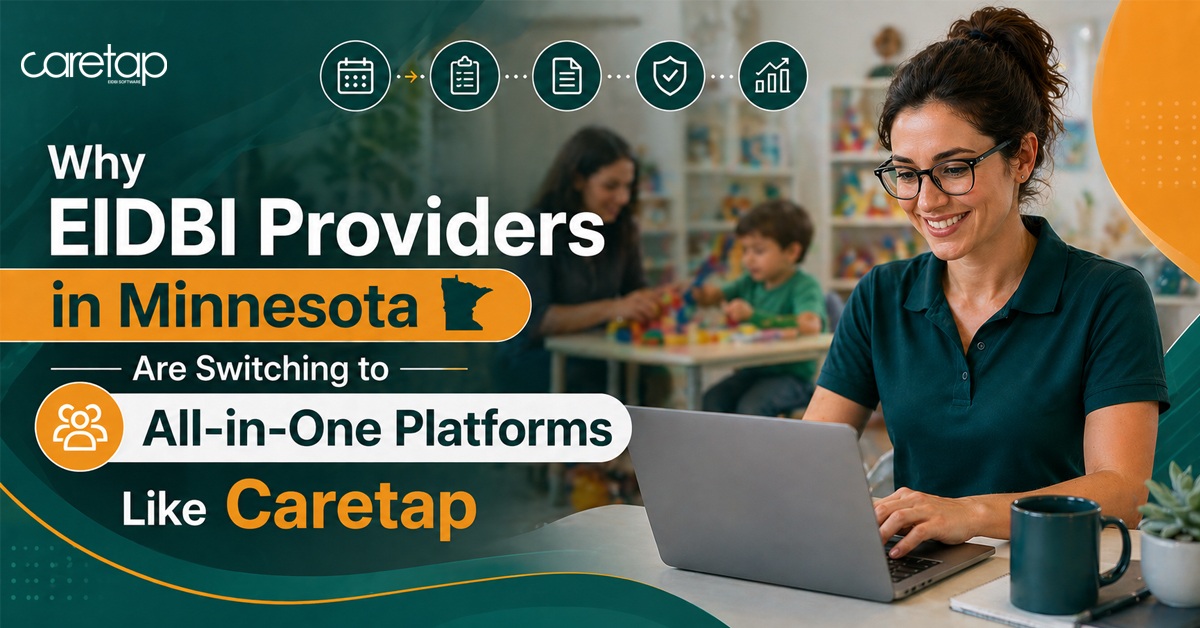

Most EIDBI providers aren’t struggling because of staffing shortages.
They’re struggling because their systems don’t work together.
Across Minnesota, agencies delivering Early Intensive Developmental and Behavioral Intervention (EIDBI) services are facing increasing operational complexity. Compliance requirements are tightening. Authorization tracking is becoming more detailed. Billing accuracy is under greater scrutiny than ever before.
But here’s the real issue: most providers are still trying to manage these complexities using disconnected tools. One system for scheduling. Another for documentation. A spreadsheet for authorizations. A separate billing platform.
The result?
Delays, errors, and operational friction at every step.
That’s why there’s a clear shift happening:
From disconnected tools to fully connected, all-in-one platforms
Understanding the EIDBI Workflow
You need to look at how EIDBI services really work to understand why this change is important.
A normal workflow looks like this:
- Setting up therapy sessions
- Providing services through BCBAs and RBTs
- Getting session data and clinical records
- Handling service approvals
- Turning finished sessions into claims that can be billed
- There is a strong link between each step.
Each step depends on the one before it being right.
Sessions are missed if the schedule is wrong.
Billing gets blocked if paperwork is late.
Claims are turned down if authorization tracking isn’t correct.
In other words, one gap in the workflow can throw the whole operation off.
The Core Problem: Fragmented Systems Are Breaking EIDBI Operations
Disconnected Scheduling
Many providers rely on multiple calendars or tools to manage schedules. This creates:
- No real-time visibility across teams
- Frequent double bookings
- Missed or overlapping sessions
Without a unified scheduling system, even simple coordination becomes complicated.
Manual Documentation Workflows
It often happens at the end of the day, or even worse, days later.
This means:
- Backlogs in notes from sessions
- Data that is not always correct or complete
- Higher risks of audits
When documentation isn’t collected in real time, it becomes less accurate and more likely to break the rules.
Authorization Tracking Gaps
Authorizations are one of the most complex parts of EIDBI operations. Yet many agencies still manage them manually.
Common issues include:
- Tracking units in spreadsheets
- Missing expiration dates
- No real-time usage visibility
These gaps often result in the delivery of services that can’t be billed.
Billing Bottlenecks
Billing depends on everything being complete and accurate.
But in fragmented systems:
- Documentation may be missing
- Session data may not match
- Claims get delayed or denied
All of this leads to one outcome: operational inefficiency and lost revenue.
Why EIDBI Providers in Minnesota Are Switching?
Administrative Overload Is Unsustainable
Managing multiple systems means constant coordination between teams.
Admins are forced to:
- Cross-check data across platforms
- Follow up with therapists
- Fix errors manually
This isn’t scalable, and it leads to burnout.
Many providers report up to a 70% reduction in admin coordination after switching to connected systems.
Real-Time Documentation Is Becoming Essential
There’s a clear shift from retrospective documentation to real-time data capture.
Benefits include:
- Higher accuracy
- Improved compliance
- Faster workflows
Providers are seeing up to 40% faster documentation completion with real-time systems.
Authorization Management Needs Automation
EIDBI authorizations involve:
- Unit limits
- Service types
- Expiration dates
Managing this manually is risky.
Automation ensures:
- Units are tracked in real time
- Alerts prevent expirations
- Services remain billable
The result: fewer denied claims and uninterrupted care delivery.
Faster Billing Means Healthier Revenue Cycle
Billing delays are often caused by incomplete workflows.
When systems are connected:
- Sessions are automatically billing-ready
- Documentation is verified in real time
- Claims are cleaner and faster to process
Providers report 25% faster billing preparation.
Leadership Needs Real-Time Visibility
Without centralized data, leadership teams are forced to make reactive decisions.
Modern platforms provide dashboards for:
- Utilization rates
- Revenue performance
- Authorization usage
This enables proactive, data-driven management.
The Shift to All-in-One Platforms
An all-in-one platform isn’t just about having multiple features.
It’s about workflow connectivity.
One system handles:
- Scheduling
- Session tracking
- Documentation
- Authorizations
- Billing
- Analytics
Everything works together in real time.
What Changes Operationally
When systems are unified:
- There’s no duplicate data entry
- No manual reconciliation between tools
- No gaps in information flow
This isn’t a software upgrade. It’s an operational transformation.
How Caretap Supports the Entire EIDBI Workflow?
Caretap EIDBI Software is built specifically to support EIDBI providers with a fully connected system.
Scheduling & Utilization
- Recurring scheduling
- Therapist assignment
- Multi-location visibility
Clinical Documentation & Session Tracking
- Real-time data capture
- Structured ABA workflows
- Supervisor review processes
Authorization Management
- Automated tracking
- Real-time usage visibility
- Expiration alerts
Billing & Revenue Workflow
- Billing-ready sessions
- Documentation verification
- Reduced claim delays
Operational & Clinical Analytics
- Productivity tracking
- Revenue insights
- Program performance visibility
Role-Based Impact
For BCBAs
- Better supervision workflows
- Real-time access to client progress
- Improved clinical decision-making
For RBTs
- Faster session data entry
- Less documentation burden
- More time focused on care delivery.
For Admin Teams
- No manual coordination between systems
- Simplified workflows
- Reduced errors
For Leadership
- Full operational visibility
- Real-time dashboards
- Data-driven decisions
Real Outcomes EIDBI Providers Are Seeing
Providers who switch to all-in-one platforms are seeing measurable improvements:
- 70% less admin coordination
- 40% faster documentation completion
- 30% better scheduling efficiency
- 25% faster billing preparation
These are measured operational improvements, not assumptions.
The Bigger Trend in Minnesota
Demand for EIDBI services continues to grow across Minnesota.
At the same time:
- Compliance requirements are increasing
- Payers expect higher accuracy
- Providers are under pressure to scale
But hiring more administrative staff isn’t a sustainable solution.
Providers who adopt connected systems scale efficiently. Others struggle to keep up.
What to Look for in an EIDBI Software Platform?
If you’re evaluating software, look for:
- Real-time data flow across all workflows
- Built specifically for ABA/EIDBI services
- Automated authorization tracking
- Integrated billing capabilities
- Advanced analytics and reporting
These aren’t “nice-to-have” features anymore; they’re essential.
The Shift Is Already Happening
The reality is simple:
The problem isn’t staffing. It’s disconnected systems.
As operational complexity increases, inefficiencies become more costly.
Delays impact both care delivery and revenue cycles.
Providers who continue relying on fragmented tools will face increasing challenges.
See How Caretap Supports Your Entire EIDBI Workflow?
The shift to connected systems is already underway, and leading EIDBI providers in Minnesota are moving fast.
If you want to:
- Reduce administrative workload
- Improve billing efficiency
- Eliminate authorization errors
- Gain full operational visibility
It’s time to see what a fully connected workflow looks like.
Book a demo with Caretap today and experience how scheduling, sessions, documentation, and billing can work seamlessly together.
See why EIDBI providers across Minnesota are simplifying operations and scaling with confidence.