


Every year, 3.6 million Americans miss or delay medical appointments due to transportation issues. Many of them are your riders.
Behind every missed appointment is a chain of operational breakdowns: a driver dispatched too late, a route planned on yesterday’s logic, a claim submitted with the wrong code. In most cases, the data that could have prevented those failures was right there, uncollected or ignored.
Here’s the question that separates the NEMT providers scaling fast from those barely staying afloat: Are you running your operation on instinct or intelligence?
This guide breaks down exactly how NEMT providers are using analytics to cut costs, improve on-time performance, pass audits with confidence, and build the kind of operational backbone that earns more broker contracts. More importantly, it shows you what to do with that data, not just how to collect it.
What Does "Analytics" Actually Mean for a NEMT Business?
Analytics gets thrown around a lot. Before we go further, let’s be specific about what it means in the context of non-emergency medical transportation, because it’s more layered than most software vendors let on.
There are four distinct types of analytics, and a well-run NEMT operation needs all four working together.
The 4 Types of NEMT Analytics and Why You Need All Four
Descriptive analytics: Trip logs, completion rates, on-time percentages, total miles driven, this is the foundation. It answers: how did we do last week?
Diagnostic analytics: Which routes caused the most delays? Which payer types generate the most claim denials? Why did three drivers miss their pickup windows on Thursday morning? This is where problems get explained, not just reported.
Predictive analytics: Using historical trip data, traffic patterns, and member behavior, you can forecast high-demand days, anticipate no-shows before they occur, and predict when a vehicle is due for maintenance before it breaks down.
Prescriptive analytics: This is the highest level, automated route rebalancing, intelligent dispatch assignment, and real-time schedule adjustments. The system doesn’t just surface insights; it acts on them.
Most NEMT providers are operating somewhere between descriptive and diagnostic. The ones pulling ahead are using predictive and prescriptive capabilities and that gap is only widening.
The True Cost of Operating Without Analytics
You might think “we’re doing fine without it.” But fine is expensive.
Without analytics, deadhead miles bleed revenue daily. Drivers are dispatched reactively, going out of their way to pick up the next scheduled trip instead of the nearest available one. Those empty miles add up to thousands of dollars a month in fuel, labor, and vehicle wear.
Without analytics, billing errors go undetected for weeks. A documentation inconsistency on a Medicaid trip sits unnoticed until a denial comes back or worse, until an audit flags a pattern. By then, you’re resubmitting claims, absorbing write-offs, and scrambling to pull documentation that should have been clean on day one.
Without analytics, compliance gaps only surface during audits. A driver’s certification quietly expired three weeks ago. A vehicle’s inspection is overdue. Nobody noticed until a state audit did. The fine isn’t just financial; it’s reputational.
Data-driven businesses are 23 times more likely to attract customers and 19 times more likely to turn a profit than those operating on guesswork. In a margin-thin industry like NEMT, that difference isn’t abstract. It’s survival.
The 8 Most Important NEMT Analytics KPIs You Must Track
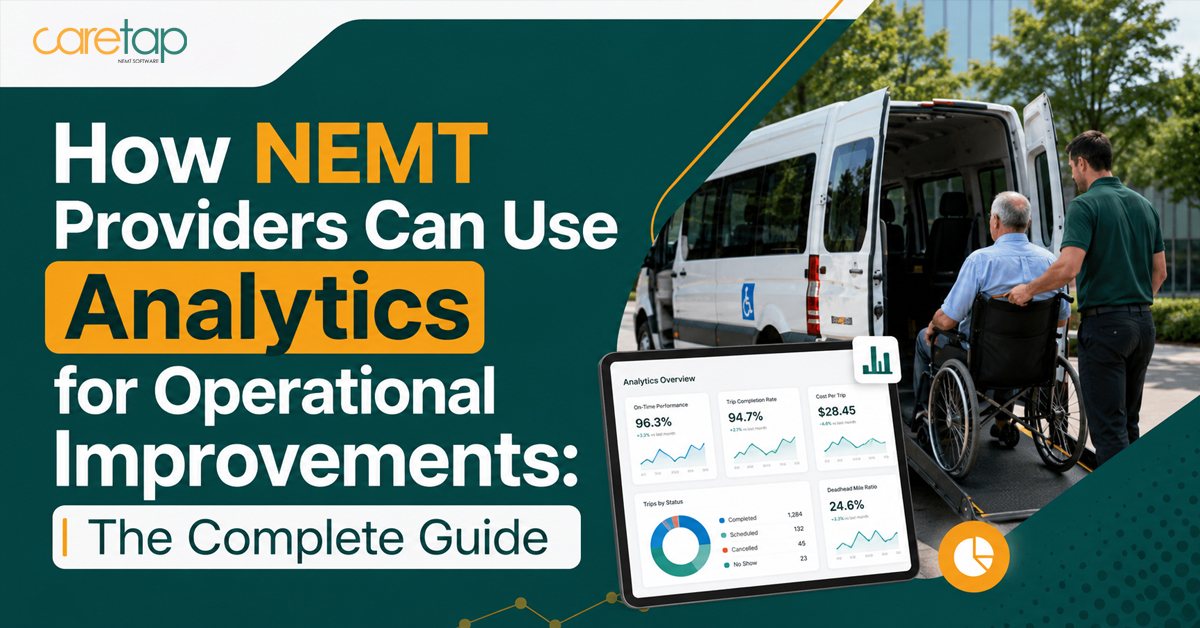
Not all data is equally worth your attention. These eight key performance indicators directly drive profitability, compliance, and broker confidence. For each one, here’s what it measures, why it matters, what “good” looks like, and how to move the needle.
On-Time Performance (OTP)
What it is: The percentage of trips where your driver arrives within the promised pickup window, the industry standard is at least 15 minutes before the patient’s appointment.
Why it matters: OTP is the single metric brokers like ModivCare and MTM use most heavily to score your operation. A consistently high OTP earns you more trip volume and more stable contracts. A declining OTP is a fast path to contract review.
Target: 95%+ for most broker contracts.
How to improve it: Analyze delay root causes by route, driver, and time of day. You’ll likely find 20% of your routes cause 80% of your delays; fix those first.
Trip Completion Rate
What it is: The percentage of scheduled trips that are actually completed versus cancelled, no-showed, or abandoned.
Why it matters: Every incomplete trip represents lost revenue and a data point brokers are watching. High cancellation rates flag unreliability.
Target: 92-96% depending on your service area and member population.
How to improve it: Segment cancellations by type, member no-show vs. provider cancellation vs. late dispatch. Each requires a different solution.
Cost Per Trip
What it is: Total operational costs (fuel, labor, insurance, maintenance) divided by the number of completed trips.
Why it matters: This is your primary profitability lever. Small reductions in cost per trip, even $2-$3, compound dramatically at scale across thousands of monthly trips.
Target: Benchmarks vary by market; track your trend and aim for consistent quarter-over-quarter reduction.
How to improve it: Route optimization, reduced idle time, and better vehicle utilization all directly reduce cost per trip.
Vehicle Utilization Rate
What it is: The ratio of time vehicles spend actively transporting passengers versus sitting idle.
Why it matters: An underutilized fleet is capital tied up doing nothing. Every idle vehicle hour is money not being made.
Target: 70-80% active utilization during operating hours.
How to improve it: Demand forecasting lets you align fleet deployment with actual trip volume. Dynamic scheduling intelligently fills gaps between trips.
Deadhead Mile Ratio
What it is: The percentage of total miles driven that are empty, with no passenger on board.
Why it matters: Deadhead miles are pure cost. Every mile driven without a passenger is fuel, labor, and wear with zero revenue attached.
Target: Below 30% is a strong benchmark; analytics-driven operations report reductions of up to 30% after implementing route optimization.
How to improve it: Multi-stop routing, return-trip pairing, and proximity-based dispatch assignment all reduce deadhead mileage.
Clean Claims Ratio
What it is: The percentage of Medicaid, Medicare, and private insurance claims accepted and paid on the first submission, without denial, correction, or resubmission.
Why it matters: Every denied claim costs you 3-5× more in administrative time to resubmit. A low clean claims ratio is a billing department trapped on a hamster wheel.
Target: 95%+ first-pass acceptance rate.
How to improve it: Pre-submission data validation, trip documentation completeness checks, and denial pattern analysis by payer and code type.
Driver Performance Score
What it is: A composite metric combining on-time rate, safety event data (harsh braking, speeding, route deviation), and rider satisfaction scores.
Why it matters: Driver performance directly affects patient experience, insurance costs, and broker scorecards. Objective data creates fair evaluations and targeted coaching opportunities.
Target: Establish a baseline in your first 90 days of tracking, then set quarterly improvement targets.
How to improve it: Share individual dashboards with drivers; visibility alone changes behavior. Pair data with structured coaching conversations.
Compliance Rate
What it is: The percentage of operational activities, driver credentials, vehicle documentation, trip records, HIPAA documentation, that are current and complete.
Why it matters: A single compliance gap can trigger claim denials, broker contract reviews, or state enforcement action. In a heavily regulated industry, compliance isn’t optional; it’s the foundation on which everything else is built.
Target: 100%. Non-negotiable.
How to improve it: Automated expiry alerts, real-time dashboards showing documentation completeness by driver and vehicle, and pre-trip checklist enforcement.
Smarter Scheduling & Dispatch Through Data
Scheduling is where NEMT analytics delivers its fastest, most visible ROI. The shift from manual dispatch to data-driven scheduling isn’t incremental; it’s transformational.
How Analytics Transforms Trip Scheduling from Guesswork to Science?
When you analyze historical trip data, patterns emerge that intuition never captures. Tuesdays at 10am are consistently your highest-volume window. Three specific zip codes generate 40% of your no-shows. Dialysis trips cluster in a 90-minute window, straining your morning fleet if not anticipated.
Demand forecasting uses this historical data to project future trip volume by day, time, geography, and trip type. Instead of scrambling to cover unexpected peaks, you’re ahead of them, staffed, dispatched, and deployed before the phones light up.
Dynamic scheduling takes it further. Rather than assigning trips manually based on a dispatcher’s familiarity with routes, AI-powered assignment considers every relevant variable simultaneously: driver proximity, vehicle type, current schedule load, trip urgency, and rider accessibility needs. The result is an assignment accuracy that no human dispatcher can replicate at scale.
No-show prediction is one of the most powerful and underused analytics capabilities in NEMT. By analyzing member behavior patterns, appointment types, time of day, and historical cancellations, your software can flag high-risk trips before they occur. Providers who act on this data strategically overbook those windows, maintaining utilization even when cancellations hit.
Route Optimization Analytics, The Fastest Way to Cut Costs
Route optimization is the analytics feature with the most straightforward ROI calculation. Providers who move from manual routing to data-driven route planning consistently report deadhead-mile reductions of up to 30% and fuel-cost reductions of 15-25%.
The math is simple: when you analyze historical trip data alongside real-time traffic patterns and member location clusters, you build routes that eliminate backtracking, maximize multi-stop efficiency, and keep drivers productive every mile they drive.
Real-time rerouting compounds these savings. When a traffic incident blocks a planned route, a connected system identifies the delay, calculates alternatives, updates the ETA, and automatically notifies the rider. No dispatcher phone tag. No late arrival logged against your OTP score.
Real-Time Trip Tracking & Completion Analytics
GPS tracking is table stakes in 2026. But most NEMT providers are using it like a rearview mirror, checking where drivers were, not using that data to drive forward decisions. Real analytics turns tracking data into operational intelligence.
What Real-Time Tracking Data Reveals?
Let’s see beyond just “Where Is the Driver?”
Dwell time analysis is one of the most underutilized insights in NEMT. When you track the time between arrival at a pickup address and the start of a trip, you can identify exactly where delays are occurring. Is it a specific facility with slow check-in processes? A driver who consistently idles before entering? A pickup address that always requires extra navigation time? Dwell time data answers questions that OTP alone cannot.
Route deviation tracking serves dual purposes. Operationally, it flags drivers who are literally cutting corners or taking inefficient paths. Compliance-wise, it generates the GPS breadcrumb documentation that Medicaid auditors increasingly request as proof of service. Every completed trip builds a timestamped, GPS-verified record that is proof of service documentation you never have to scramble to produce.
Trip completion timestamps trigger everything downstream: billing, compliance logging, and broker reporting. When that timestamp is automatically recorded and synced the moment a trip closes, you eliminate the lag between service delivery and claim submission that costs providers days of cash flow delay.
How Completion Rate Analytics Improve Broker Relationships
Here’s a reality that most providers underestimate: your brokers are already analyzing your completion data. ModivCare, MTM, and other major NEMT brokers use on-time performance, completion rates, and exception frequency to score providers and allocate trip volume. Your analytics should be ahead of theirs, not reactive to their reports.
Completion rate analytics broken down by trip type, time of day, driver, and geography tells you exactly where your exceptions are concentrating. When you find that 60% of your missed trips come from a two-hour window on Friday afternoons in one service zone, you can fix it before your broker’s quarterly review flags it.
Exception reporting, automatically surfacing trips that deviated from plan, lets you investigate, document, and resolve issues internally. Providers who arrive at broker reviews with their own detailed exception analysis project a level of operational maturity that directly translates to more contracts.
Billing Analytics: How Data Speeds Up Revenue and Cuts Claim Denials
If there’s one area where NEMT analytics is almost universally underutilized, it’s billing. Providers invest heavily in scheduling and tracking tools, then leave billing analytics as an afterthought and it costs them significantly.
The Billing Data You're Probably Leaving on the Table
Denial pattern analysis is the highest-value analytics task most NEMT billing teams aren’t doing. When a claim is denied, it’s typically logged, corrected, and resubmitted, but never analyzed. The pattern that caused that denial, if it recurs across 50 trips a month, represents thousands of dollars in delayed or lost reimbursement. Billing analytics surfaces those patterns: which codes generate the most denials, which payers reject most frequently, and which documentation fields are consistently incomplete.
Revenue per trip by payer, service line, and geography provides a clear picture of where your operation actually makes money. Not all trips are equal. A 5-mile Medicaid trip to a dialysis clinic and a 40-mile private-pay ride to a specialist generate very different margins. Analytics shows you which service lines to scale, which to reconsider, and where to negotiate better rates.
Days-to-payment by payer is a cash flow visibility metric that most NEMT operators track only loosely. When you know that Medicaid in your state consistently pays in 18 days while a specific private insurer averages 47 days, you can plan cash reserves and collections follow-up accordingly.
How Faster Claims Submission Starts With Better Trip Data
Billing speed is a downstream product of field data quality. When a driver uses a mobile app to log trip completion with a digital signature, timestamped GPS confirmation, and completed documentation checklist, that trip record arrives in your billing system clean, complete, and ready to submit. There’s no data entry step. There’s no “did the driver fill in the mileage?” question. The claim can be triggered within minutes of the trip closing.
Pre-submission validation catches errors when they’re easy to fix by checking trip records against authorization numbers, member eligibility, and billing code requirements before they leave your system, rather than after a denial forces you to reconstruct documentation weeks later.
Multi-payer analytics on a single dashboard means your billing team isn’t toggling between systems for Medicaid, Medicare, and private.
insurers. Unified reporting reveals the full picture of your revenue cycle in one place.
Driver & Vehicle Analytics: Managing Your Most Expensive Assets
Your drivers and vehicles are the largest cost centers in your operation. They’re also the areas where gut-feel management is most common and most costly.
Building an Objective Driver Performance Dashboard
Traditional driver evaluation is subjective: a dispatcher’s impression, a complaint phone call, the sense that someone is “a good driver.” This approach creates blind spots, inconsistency, and legal exposure. Objective driver analytics replaces all of it.
A composite driver performance score pulls from multiple data streams simultaneously: GPS-verified on-time rate by trip, safety event frequency (harsh braking, sharp acceleration, speeding), route adherence, rider satisfaction ratings, and trip completion consistency. This gives you a complete, defensible picture of every driver’s performance that goes far beyond “did they arrive on time?”
Safety data has a direct financial impact that many providers overlook. Drivers who generate consistent harsh braking and speeding events cost more in vehicle wear, fuel waste, and insurance premiums. Fleets that use safety analytics to coach and correct driver behavior report measurable insurance cost reductions over time.
Driver utilization analytics adds another dimension: not just how well a driver performs, but how efficiently they’re deployed. Idle time per shift, trips completed per operating hour, and average trip distance reveal whether your team is being scheduled effectively or leaving productivity on the table.
Fleet Analytics for Predictive Maintenance and Lower Downtime
Reactive vehicle maintenance is one of the most avoidable cost centers in NEMT. A vehicle that breaks down during an active trip doesn’t just cost repair money; it costs you a missed trip, a cancelled patient appointment, a potential OTP violation with your broker, and the dispatching overhead of emergency reallocation.
Mileage-based maintenance alert systems, integrated with your trip data, generate automatic service reminders calibrated to actual vehicle usage, not a calendar date or a dispatcher’s memory. Oil changes, brake inspections, tire rotations, and required safety checks are all trackable and schedulable before failure, not after.
Vehicle utilization analytics also surfaces a question most operators aren’t asking: which vehicles in your fleet are actually earning their keep? When analytics shows that two vehicles in your fleet are completing 40% fewer trips than the fleet average, you have the data to ask whether those assets should be redeployed, upgraded, or replaced.
Vehicle-level fuel efficiency tracking adds another layer. When one vehicle consistently burns 20% more fuel per mile than comparable units, you have an objective basis for prioritizing its maintenance or replacement, before it quietly erodes your margins for another 18 months.
License, registration, and inspection expiry tracking, tied to your operational dashboard, ensures compliance documentation gaps never quietly slip through. Every vehicle’s compliance status is visible, proactively flagged, and resolved before it becomes an audit exception or a broker compliance violation.
Compliance Analytics: How Data Keeps You Audit-Ready, Always
In NEMT, compliance is not a department; it’s an operational posture. And in 2026, the regulatory environment is more demanding than ever. New HIPAA cybersecurity requirements, evolving Medicaid policies, and stricter fraud-prevention enforcement mean that providers who rely on manual compliance tracking are taking on risks they may not fully recognise.
What NEMT Compliance Analytics Actually Monitors
A comprehensive compliance dashboard simultaneously tracks four critical areas.
Driver credential currency: Licenses, certifications (defensive driving, CPR, first aid, PASS), background check renewal dates, and drug screening compliance, all tracked with automated expiry alerts. When a certification is 30 days from expiry, the system flags it. When it expires, the system prevents trip assignment until it’s renewed.
Vehicle documentation compliance: Inspection status, registration, insurance certificates, and safety equipment certification, updated in real time against trip assignment eligibility. A vehicle with a lapsed inspection isn’t dispatched. Period.
HIPAA documentation completeness per trip: Ensuring that every trip record contains the required protected health information fields, consent documentation, and audit trail. Not checked manually by a billing administrator who’s also doing three other things. Checked automatically, every trip, every time.
Medicaid billing code accuracy: Pre-submission validation against payer-specific code requirements catches documentation mismatches before they trigger denials or, worse, fraud investigations. Clean, compliant billing isn’t just a revenue issue; it’s a license issue.
The Real Consequence of Ignoring Compliance Data
Non-compliance in NEMT isn’t a paperwork problem. Federal and state agencies have significantly increased enforcement activity in recent years, with consequences that go well beyond fines.
Claim denials and reimbursement clawbacks happen when Medicaid audits identify billing irregularities. A pattern of improperly documented trips, even if services were genuinely delivered, can trigger large-scale reimbursement demands that destabilize a provider’s cash flow.
For multi-state operators, the compliance challenge multiplies. Every state has its own driver certification requirements, vehicle specifications, trip documentation standards, and billing procedures. Managing all of that manually across multiple service areas is, frankly, not possible at scale. Analytics-driven compliance management, where every requirement is mapped, tracked, and enforced automatically, is the only way to operate in multiple markets without compounding risk.
The business case is straightforward: the cost of compliance analytics is a fraction of the cost of a single significant audit finding.
Mobile Analytics: Why Your App Data Matters as Much as Your Dashboard
The analytics conversation in NEMT typically focuses on dashboards and reports, the outputs. What often gets overlooked is the field-level data capture that enables effective analytics: the mobile apps used by office staff, drivers, and riders.
Three Streams of Mobile Data Working for You Simultaneously
Office staff app: Real-time dispatch decisions informed by live KPI feeds, not spreadsheets. When your dispatcher can see vehicle locations, driver availability, current schedule load, and incoming trip requests on a single mobile screen, every assignment decision is made with full operational context. The decisions are faster, smarter, and automatically logged, creating a continuous audit trail of dispatching actions.
Driver app: Automatic trip logging, digital signature capture, GPS breadcrumb recording, and pre-trip inspection checklists, all without manual data entry. The driver completes a trip, logs arrival and departure, captures the rider’s digital signature, and closes the record. That data syncs immediately to your central system: triggering the billing record, updating the compliance log, and adding to the driver’s performance analytics. No paper. No transcription errors. No lag.
Rider app: Automated ETA notifications reduce rider anxiety and, critically, reduce no-shows. When riders receive real-time updates about their driver’s arrival, missed connection rates drop. The rider app also captures post-trip satisfaction ratings at scale, providing continuous feedback that directly feeds into driver performance analytics and service quality monitoring.
How Mobile Data Feeds Your Central Analytics Engine?
The value of mobile data isn’t just in what each app captures individually. It’s in how the three data streams converge.
Field data from the driver app, combined with dispatch records from the office app and feedback from the rider app, creates a complete trip-level data record with no gaps. That record feeds your scheduling analytics (informing future routing decisions), your billing system (triggering clean, complete claims), and your compliance dashboard (confirming documentation completeness), all from a single trip event.
This is the closed-loop data model that sets analytics-driven NEMT operations apart from the rest. The field and the office are no longer operating on different information. They’re operating on the same, real-time truth.
How Caretap Turns NEMT Analytics Into Action?
Understanding analytics is one thing. Having software that automatically captures, connects, and surfaces that data across every trip, every driver, and every claim is something else entirely. That’s exactly what Caretap is built to do.
Here’s how each core Caretap feature functions as an analytics engine, not just an operational tool.
Scheduling and Dispatch
Caretap’s scheduling platform is demand-aware, not just calendar-aware. It tracks assignment efficiency, driver response time, and schedule load in real time, giving dispatchers a live KPI view alongside every trip assignment decision. Demand patterns built from your historical data feed forward into smarter scheduling: fewer gaps, fewer scrambles, fewer missed trips.
The result isn’t just better scheduling. It’s a continuous improvement cycle: every trip you dispatch generates data that makes the next dispatch smarter.
Easy Trip Tracking and Completion
Every trip in Caretap generates a GPS-verified, timestamped record from dispatch through completion. Driver location, dwell time, route adherence, and trip duration are automatically captured, without the driver doing anything beyond their normal workflow.
That tracking data does triple duty: it feeds your OTP analytics, it provides Medicaid-compliant proof-of-service documentation, and it generates the broker-ready performance records you need to win and maintain contracts. Real-time visibility for dispatchers means exceptions are caught and corrected while the trip is still happening, not discovered in a next-week report.
Faster Billing and Claims Submission
Caretap closes the gap between trip completion and claim submission to near-zero. When a trip closes with a digital signature, GPS confirmation, and completed documentation, the system auto-populates the billing record and validates it against payer requirements before submission.
Caretap’s billing analytics dashboard tracks your clean claims ratio, denial patterns by payer and code type, and days-to-payment across your entire payer mix. You always know the health of your revenue cycle, not just your trip volume.
Mobile App for Office Staff, Drivers, and Riders
Caretap’s three-way mobile architecture creates the closed-loop data model described above. Office staff manage dispatch in real time. Drivers log trips, capture signatures, and complete compliance checklists, automatically syncing every action to central records. Riders receive ETA alerts that reduce no-shows and rate their experience after every trip.
The three apps don’t just make each group’s job easier. They create a continuous, real-time data feed that makes your entire operation more intelligent with every trip completed.
Driver and Vehicle Management
Caretap’s driver management module generates composite performance scores from GPS data, safety events, completion rates, and rider feedback, giving you objective, defensible performance records for every driver in your fleet.
Vehicle management goes beyond scheduling. Caretap tracks maintenance intervals against actual mileage, surfaces vehicles approaching service thresholds, and monitors compliance documentation expiry across your fleet. Your vehicles are managed proactively, never reactively.
Stay 100% Compliant
Caretap’s compliance dashboard monitors driver credentials, vehicle documentation, HIPAA trip records, and billing code accuracy simultaneously, with automated alerts before anything lapses.
For multi-state operators, Caretap maps compliance requirements by service area, ensuring that state-specific standards are tracked separately and enforced locally. Every audit request becomes a dashboard export, not a documentation scramble. Compliance isn’t something you achieve once a year before a review. It’s a live operational status you can see at any moment.
Step-by-Step: How to Build a Data-Driven NEMT Operation
The analytics capabilities described in this guide aren’t theoretical. Thousands of NEMT providers are implementing them right now, and the ones doing so most effectively share a common approach.
Step 1: Audit your current data. Before adding new tools, understand what you’re already collecting and where it lives. Are trip records in a scheduling system, billing in a separate platform, and compliance tracking in a spreadsheet? Data siloed across three systems produces three partial pictures, not one complete one.
Step 2: Define your two or three priority KPIs. You don’t need to track everything at once. Start with on-time performance, cost per trip, and clean claims ratio, the three metrics with the most direct impact on profitability and broker relationships. Establish baselines in month one, then set 90-day improvement targets.
Step 3: Choose integrated NEMT software. The single most important technology decision is integration. A scheduling tool that doesn’t talk to your billing system, which doesn’t talk to your compliance tracker, produces fragmented data and fragmented insights. A platform that unifies scheduling, dispatch, tracking, billing, and compliance through a single data layer is the foundation of everything else in this guide.
Step 4: Train your team on data habits, not just software features. Analytics tools only produce value when the people using them know how to act on what they see. Dispatchers need to understand what the OTP data reveals about tomorrow’s schedule. Billing staff need to review denial patterns weekly, not monthly. Drivers need to understand that their mobile app data feeds into their performance score and that the score is what earns them better shifts. Data literacy is as important as the data itself.
Step 5: Review weekly, improve monthly. Schedule a standing weekly KPI review, 30 minutes, the same metrics every week. Flag the outliers, assign action owners, and track resolution. Monthly, zoom out: are your trends moving in the right direction? Are the improvements you targeted 90 days ago materializing? The cadence of acting on insights, not just viewing them, is what separates analytics-driven operations from operations that have analytics software but run on intuition anyway.
The Bottom Line
The NEMT providers pulling ahead in 2026 aren’t working harder than their competitors. They’re seeing more clearly.
They know, before the day starts, where demand will peak. They know, before a claim is submitted, whether it will clear. They know, before an audit arrives, whether their compliance is airtight. That clarity doesn’t come from instinct built over years in the business. It comes from data collected consistently, connected intelligently, and acted on systematically.
Analytics transforms every part of a NEMT operation: scheduling becomes proactive, dispatch becomes precise, billing becomes faster and cleaner, drivers become objectively coachable, fleets become predictively maintained, and compliance becomes a continuous state rather than a periodic scramble.
Caretap was built to give every NEMT provider, whether you run 5 vehicles or 500, the analytics infrastructure to operate smarter, grow confidently, and serve your riders with the reliability they depend on.