



“Most ABA practices don’t fail; they collapse under growth.”
That might sound dramatic, but it’s what actually happens in the real world.
You finally start getting referrals. Your caseload increases. Revenue begins to climb. On paper, everything looks like success.
But behind the scenes?
- Scheduling becomes a daily fire drill
- Staff feel overwhelmed and stretched
- Billing gets delayed or denied
- Leadership gets pulled into everything
Growth, without structure, creates operational chaos.
The Hidden Problem
Growth doesn’t automatically mean progress. In ABA, it often means:
- More moving parts
- More compliance requirements
- More dependency on people and processes
Without systems, growth amplifies inefficiencies.
Who This Guide Is For
- ABA clinic owners looking to scale sustainably
- BCBAs expanding their teams
- Multi-location providers managing complexity
What You’ll Get
This isn’t a list of surface-level tips.
This is a system-driven growth playbook to help you:
- Scale your ABA practice without burnout
- Build operational clarity
- Increase revenue without proportional cost
What “Scaling” Really Means in ABA And Why Most Get It Wrong
Let’s clear up a critical misconception.
Growth vs Scaling
- Growth = Adding more resources to increase revenue
(More staff, more costs, more complexity) - Scaling = Increasing revenue without proportional increases in cost
In other words:
- Growth adds weight
- Scaling builds efficiency
Why ABA Is Uniquely Complex?
Scaling an ABA practice isn’t like scaling a typical business. You’re dealing with:
- Strict staffing ratios (RBTs to BCBAs)
- Authorization limits from payers
- Insurance dependency for revenue
- Clinical compliance requirements
That’s why most ABA practice growth strategies fail; they ignore operational reality.
The Number 1 Reason ABA Practices Experience Chaos During Growth
It’s not a lack of demand.
It’s not staffing shortages.
It’s this:
Scaling without systems
Most practices try to grow while still relying on:
- Manual scheduling
- Spreadsheet-based tracking
- Disconnected billing workflows
- Reactive leadership decisions
The Result?
- Leadership bottlenecks
- Missed sessions
- Billing delays
- Staff burnout
These are classic ABA operational challenges and they only get worse with growth.
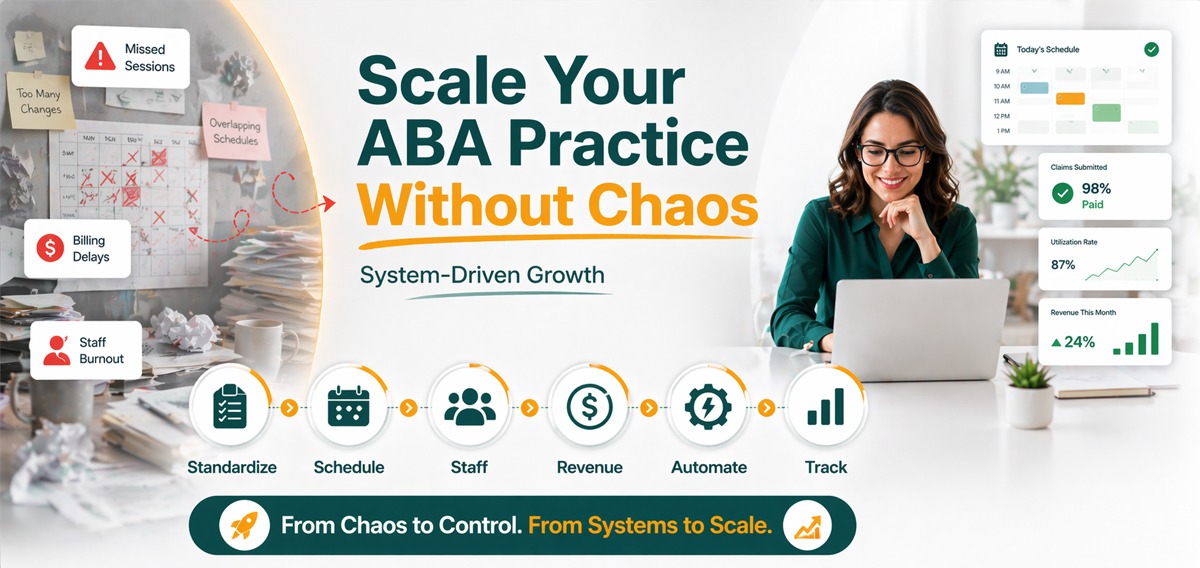
The 5 Pillars of Scalable ABA Practice Growth
If you want to scale without chaos, everything you do should align with these five pillars:
- Clinical Scalability: Standardized treatment planning and documentation
- Operational Infrastructure: Systems for scheduling, coordination, and visibility
- Financial Systems: Clean, predictable revenue workflows
- Staffing & Culture: Retention-driven, not just hiring-driven
- Technology & Automation: Reducing manual workload across the board
Step-by-Step: How to Scale an ABA Practice Without Chaos
1. Standardize Your Clinical Processes First
Before you grow, you need consistency.
Create SOPs for:
- Assessments
- Treatment plans
- Session documentation
Why this matters:
Consistency = predictability
Predictability = scalability
Without standardized ABA clinical workflows, every new hire creates variability.
2. Build a Scalable Scheduling System
Scheduling is the heartbeat of your practice and often the biggest bottleneck.
Move from:
Manual coordination to centralized scheduling systems
You need visibility into:
- Therapist availability
- Client preferences
- Location constraints
A strong system helps you:
- Eliminate overlaps
- Reduce cancellations
- Improve utilization
This is where ABA scheduling optimization becomes critical.
Switch to Smart Scheduling with Caretap ABA Software
3. Fix Your Staffing Model Before Hiring More
Hiring more people won’t fix broken systems.
Define:
- Ideal RBT-to-BCBA ratios
- Target utilization rates
- Capacity limits
Avoid:
- Over-hiring (kills margins)
- Under-hiring (creates burnout)
Use demand trends to guide hiring decisions.
A strong ABA staffing model ensures sustainable growth.
4. Implement a Strong Revenue Cycle System
Your revenue should flow like this:
Session → Documentation → Claim → Payment
If any step breaks, cash flow suffers.
Fix:
- Incomplete documentation
- Delayed claim submissions
- Lack of billing visibility
A strong ABA revenue cycle management system helps you:
- Reduce denials
- Speed up payments
- Gain financial control
5. Automate Everything That Slows You Down
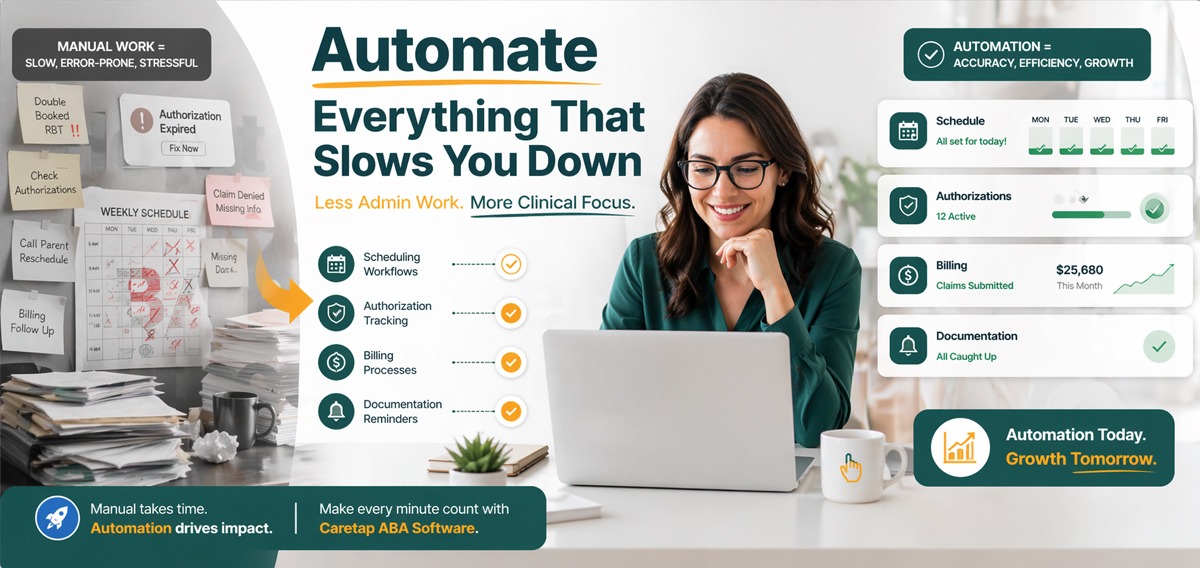
Manual work is the enemy of scale.
Automate:
- Scheduling workflows
- Authorization tracking
- Billing processes
- Documentation reminders
The goal is simple:
- Less admin work
- More clinical focus
This is where ABA automation software becomes a growth multiplier.
Start Automating Scheduling, Billing & More with Caretap Today
Scaling without data is gambling.
- Utilization rates
- Attendance rates
- Authorization usage
- AR days (accounts receivable)
These ABA performance metrics act as your control system.
Without them, problems stay hidden until they explode.
7. Create a Layered Leadership Structure
If everything depends on you, scaling will break you.
You need:
- Clinical Director
- Operations Manager
- Billing oversight
Delegate:
- Decisions
- Accountability
- Performance tracking
A strong ABA leadership structure prevents founder burnout.
8. Improve Client Intake & Onboarding Speed
Growth bottleneck no one talks about:
Slow onboarding
Fix your ABA intake process by streamlining:
- Insurance verification
- Authorization approvals
- Scheduling setup
Faster onboarding = faster revenue realization.
9. Optimize Therapist Productivity Without Burnout
Productivity doesn’t mean overworking your team.
Focus on:
- Smart scheduling
- Balanced caseloads
- Built-in breaks
Retention strategies:
- Flexibility
- Support systems
- Clear expectations
Strong ABA staff retention strategies protect your growth.
10. Expand Locations (The Right Way)
Opening a new center too early can destroy your systems.
Before expanding:
- Stabilize your first location
- Standardize operations
- Ensure leadership depth
Use a hub-and-spoke model for better control.
Scaling a multi-location ABA practice requires discipline, not speed.
Signs Your ABA Practice Is Scaling Successfully Vs Chaotically
Healthy Scaling Indicators
- Stable or improving profit margins
- Low claim denial rates
- High staff retention
- Consistent clinical outcomes
Chaos Indicators
- Constant scheduling issues
- Frequent staff burnout
- Cash flow delays
- Compliance risks
Recognizing these ABA growth challenges early can save your practice.
Common Mistakes That Kill ABA Practice Growth
Avoid these at all costs:
- Scaling without systems
- Ignoring performance data
- Hiring too fast
- Avoiding technology investment
- Founder micromanagement
These are the most common ABA scaling mistakes and they’re completely preventable.
Technology Stack Needed to Scale an ABA Practice
To scale effectively, you need four core systems:
- Scheduling
- Documentation
- Billing
- Reporting
The problem?
Most practices use disconnected tools.
Why That Fails?
- Duplicate work
- Data inconsistencies
- Lack of visibility
The Better Approach
Use an all-in-one ABA practice management software that connects:
- Scheduling
- Session tracking
- Authorizations
- Billing workflows
- Analytics
This creates:
- Real-time visibility
- Reduced admin workload
- Faster decision-making
This is the difference between managing growth and controlling it.
Explore how Caretap ABA Software helps you scale without chaos
Real-World Scaling Scenario
Before Systems
- Missed sessions due to scheduling gaps
- Billing delays from incomplete documentation
- Leadership overwhelmed with daily issues
After Implementing Systems
- Increased therapist utilization
- Faster claim submissions
- Improved revenue predictability
- Reduced administrative workload
This shift is what turns chaos into control.
Weekly Scaling Checklist
Use this every week to stay in control:
Review:
- Staff utilization rates
- Scheduling gaps
- Authorization usage
- Claims submitted vs pending
Fix Immediately:
- Missed sessions
- Documentation delays
- Billing bottlenecks
Evaluate:
- Hiring needs
- Operational inefficiencies
This checklist keeps your ABA operations management tight.
Conclusion: Scale with Systems, Not Stress
Growth in an ABA practice doesn’t have to feel chaotic; it only does when systems are missing. The practices that scale successfully aren’t just adding more clients or staff; they’re building control, visibility, and automation into every part of their operations. When your scheduling is predictable, your billing flows consistently, and your team knows exactly how to execute, growth stops creating stress and starts creating momentum.
Chaos isn’t a phase of growth; it’s a signal that something needs structure. Start building your scalable ABA system today by connecting your workflows, automating repetitive tasks, and gaining real-time performance insights. Because scaling your ABA practice shouldn’t feel like survival, it should feel like clear, confident progress.