

Your home care agency fixes a missed clock-in on Monday. The following Monday, the same caregiver misses the same clock-in at the same client’s home, and someone fixes it again. Every one of those fixes is quietly lowering your score.
Most Minnesota agencies know manual EVV entries are a problem. Fewer know exactly how DHS counts them, or why correcting the record does nothing for compliance. DHS began enforcing EVV compliance thresholds on Jan. 1, 2026, and since July 1, 2026, providers must hold at least an 80% compliance rate. Agencies that fall short face payment holds or enrollment termination, so that gap now has a real cost.
This guide to Minnesota EVV manual edits covers how DHS treats corrections, where the live-in caregiver exception fits, and a 30-minute weekly routine that stops the same visits from breaking again.
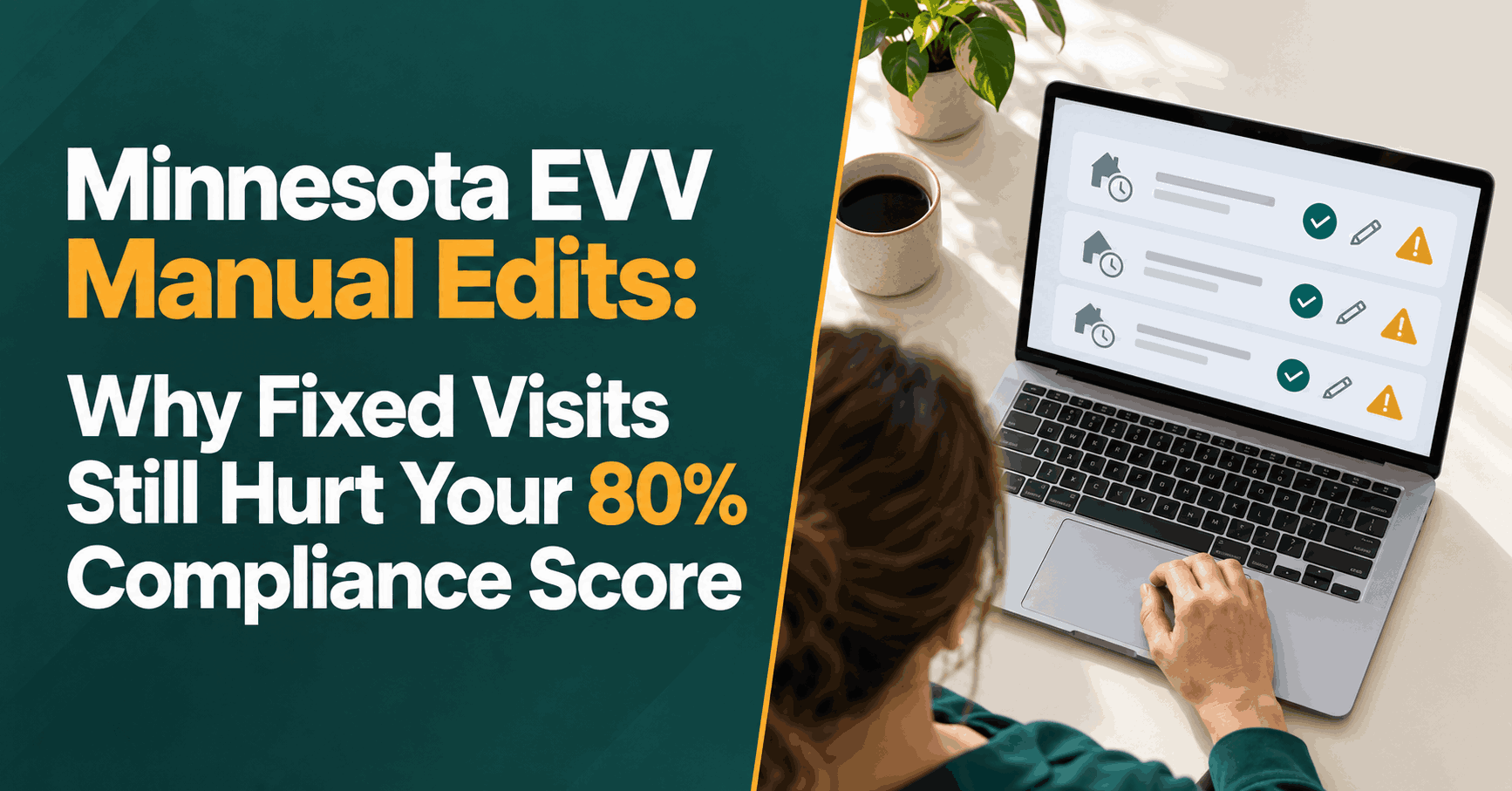
In Minnesota, manually entered or corrected EVV visits are EVV noncompliant visits, even when the corrected times are accurate. You still submit them for claims review and billing, but they count against your 80% rate. The only exclusion is properly identified live-in caregiver visits. Reducing corrections means fixing the training, access, and process issues that cause them.
What counts as a manual EVV edit in Minnesota?
Original capture means the caregiver verified the visit in real time, at the start and end of the shift, using an approved method: the mobile app, telephony (IVR), or a fixed object device (FOB). This is what DHS means by EVV real-time verification.
A manual EVV correction is anything added or changed after the fact. That includes a missed clock-in the scheduler fills in, an adjusted end time, or a visit typed in from a paper timesheet.
DHS treats all of these the same way. Manually entered visits, corrected visits, and visits not verified during the service are noncompliant because they weren’t captured in real time. The policy states plainly that manual entries should be rare.
Why an accurate correction is still a noncompliant visit?
This is where most agencies get tripped up. A corrected visit can be completely accurate: the caregiver really was there from 9:00 to 1:00, and the office entered it faithfully. DHS still separates two ideas.
Confirmed visit | Compliant visit | |
Has the required EVV data | Yes | Yes |
Available for claims review (billable) | Yes | Yes |
Verified in real time | Not required | Required |
Counts toward your 80% rate | Counts against it if manual | Counts toward it |
So an accurate correction keeps the visit available for billing, but it still lowers your Minnesota EVV compliance percentage. You also can’t hide it. DHS requires providers to report all EVV data, including manual entries and noncompliant visits. Submitting only compliant visits doesn’t meet the data submission requirement, and DHS may audit providers whose data looks incomplete.
Treat each correction as documentation of a problem that already happened. Every one should prompt the same question from your office: why did this visit need fixing?
The live-in caregiver EVV exception in Minnesota
Live-in caregivers are the one real exception. DHS doesn’t require them to interact with EVV in real time, though they still have to enter all their entries and shifts into the EVV system daily. Agencies can choose to require real-time use anyway.
Properly identified live-in caregiver EVV visits are excluded from compliance calculations. The catch is setup. Agencies using the exception need a way to identify live-in visits in the EVV system, such as a tag. Per DHS, manual entries that aren’t properly identified as live-in caregiver visits are included in your compliance rate like any other.
One misconfigured profile can pull your percentage down every single week without anyone noticing. If your rate looks lower than your correction volume explains, check your live-in flags first.
Why the same EVV clock-in problems keep coming back?
DHS says frequent manual entries usually point to training needs, workflow issues, or technology barriers. In practice, most recurring EVV clock-in problems fall into three groups.
Cause | What it looks like | What to change |
Training | A new hire never activated the app. A caregiver assumes “no signal” means no clock-in. Someone forgets to check the “community” box when clocking in or out more than 500 feet from the client’s home. | Activate the app during onboarding with the caregiver present. Show that the mobile app works without internet or cell service. Run short refreshers in the caregiver’s own language. |
Access | No smartphone and no registered phone number for IVR. A dead battery. A caregiver using the client’s own smartphone or tablet for the app, which DHS doesn’t allow outside a narrow self-directed exception. | Register current client phone numbers for IVR. Issue an agency smartphone or tablet where it fits. Confirm every caregiver has working login credentials. |
Process | The client’s phone number or address changed but the profile didn’t. Live-in caregiver visits aren’t tagged. The office fixes visits by default instead of calling the caregiver. | Update profiles whenever details change. Audit live-in tags monthly. Require a same-day call to the caregiver before any correction. |
DHS device rules behind many repeat corrections
A few details from the DHS verification methods and device usage policies explain a lot of repeat HHAeXchange manual visit entries:
- EVV telephony (IVR) in Minnesota is a fallback. It’s allowed only when the caregiver doesn’t have a smart device for the mobile app and the visit begins and ends in the person’s home. A visit that starts or ends in the community needs the mobile app.
- Agencies must enter at least one phone number registered to the person’s profile before a caregiver can clock in by phone. If that’s the person’s own phone, the agency must document their permission in the person’s record.
- Caregivers can’t use the mobile app on a smartphone or tablet owned by the person receiving services. The one exception is self-directed services where the support plan documents the device is used only for EVV.
- DHS doesn’t provide or reimburse EVV devices. Agencies are responsible for making sure caregivers have device access, and agency-issued devices are allowed.
Seeing the same names on your correction list every week?
Book a Caretap demo and we’ll walk through your exception patterns with you.
A 30-minute weekly checklist to cut manual EVV corrections
Pick a fixed day, block 30 minutes, and work through this list:
- Pull last week’s EVV manual entries in Minnesota and all corrections.
- Sort them by caregiver, client, and reason.
- Flag anyone with more than one correction in the week.
- Call each flagged caregiver and ask what happened, not just when.
- Update client phone numbers, addresses, and live-in tags.
- Confirm new hires have activated the app and completed a successful clock-in.
- If you use a third-party EVV system, confirm every visit reached HHAeXchange, including noncompliant ones.
- Check your running compliance rate against the 80% line, and review each monthly HHAX compliance report when it arrives.
Writing down the reason each week turns corrections into data. After a month, you’ll usually see that a handful of caregivers or clients drive most of the problems, and those are the fixes worth your time.
How EVV software reduces manual corrections?
Software can’t make a caregiver clock in, but it shapes how often corrections happen and how fast you notice them. When you compare EVV systems, look for three things:
- Exception reports you can check mid-week, before problems pile up
- A required note on every manual edit, so the reason is captured at the source
- More than one verification method, so caregivers without a smartphone aren’t stuck
Caretap is headquartered in Minnesota. It records the date, time, and service provided for each home care visit, reports location and shift start and end times in real time, and includes exception-based reporting. Caregivers who need it can also verify visits by telephone from the client’s landline.
If recurring corrections are dragging your agency toward the 80% line, a short review of your exception patterns usually shows where to start.
Book your Caretap EVV demo and we’ll walk through your correction data with you.
Minnesota EVV manual corrections: FAQ
Do manual EVV corrections count as compliant in Minnesota??
No. Manually entered and corrected visits are noncompliant because they weren’t verified in real time. The exception is properly identified live-in caregiver visits, which are excluded from the calculation.
Should we stop submitting corrected visits to protect our percentage?
No. DHS requires you to report all EVV data, including manual entries and noncompliant visits. Submitting only compliant visits doesn’t meet the data submission requirement.
Can a caregiver use the client’s phone to clock in?
Not through the mobile app. DHS doesn’t allow caregivers to use the EVV app on a smartphone or tablet owned by the person receiving services, except in self-directed services where the support plan documents the device is used only for EVV. A caregiver without a smart device can use telephony (IVR) from a phone number registered to the person’s profile, if the visit starts and ends in the home and the agency has documented the person’s permission to use their phone.
Can caregivers use IVR if the visit starts outside the home?
No. IVR can only be used when the visit begins and ends in the person’s home, and only when the caregiver doesn’t have a smart device for the mobile app. Visits that start or end in the community need the mobile app.