



Most ABA practices don’t fail because of poor clinical care; they struggle because they lack visibility into what’s happening operationally.
The hidden cost?
Missed sessions that go unnoticed. Claims that sit unsubmitted. Staff inefficiencies that quietly drain revenue week after week.
Applied Behavior Analysis (ABA) practices operate at the intersection of clinical care, staffing logistics, and complex billing systems. That means small inefficiencies compound quickly.
Tracking performance monthly is simply too slow.
By the time you identify a problem:
- Revenue has already been lost
- Authorizations may have expired
- Staff burnout has already begun
Weekly KPI tracking changes that.
It allows you to:
- Catch issues early
- Make faster operational decisions
- Improve both care quality and financial performance
In this guide, you’ll learn:
- What ABA practice KPIs actually are
- The most important weekly metrics to track in 2026
- Benchmarks to measure your performance
- How to build a simple, effective KPI system
What Are KPIs in ABA Practice Management?
Key Performance Indicators (KPIs) are measurable values that show how effectively your practice is achieving its goals.
In ABA, KPIs sit across clinical, operational, and financial workflows.
KPIs vs Metrics vs Outcomes
- Metrics: Raw data (e.g., number of sessions completed)
- KPIs: Strategic indicators tied to performance (e.g., session completion rate)
- Outcomes: Results (e.g., patient progress, revenue growth)
Why KPI Tracking Matters in ABA?
ABA practices must manage:
- Insurance authorizations
- Real-time clinical documentation
- Staff scheduling across clients
- Complex billing cycles
Without structured ABA data tracking, practices rely on guesswork.
Additionally, payer expectations and compliance requirements are increasing. Clean documentation, timely billing, and utilization tracking are no longer optional.
Data-driven decision making is now a competitive advantage.
How Weekly KPI Tracking Improves Revenue & Care Quality?
Weekly tracking helps you identify problems before they escalate.
What You Can Catch Early?
- Missed or incomplete sessions
- Delayed claims submissions
- Underutilized staff
- Authorization gaps
Impact on Your Practice
Revenue Cycle Management
- Faster claims = faster payments
- Reduced denials
- Improved cash flow
Clinical Outcomes
- Consistent session delivery
- Better tracking of treatment progress
Patient Satisfaction
- Fewer cancellations
- More predictable care schedules
Mini Scenario - Example
A mid-sized ABA clinic noticed a drop in revenue. Monthly reports didn’t show much.
After switching to weekly KPI tracking, they discovered:
- 18% of sessions were not being billed on time
- Authorizations were underutilized by 22%
Within 6 weeks:
- Billing delays dropped by 30%
- Revenue increased without adding new clients
That’s the power of ABA clinic analytics done weekly.
Core Categories of ABA KPIs
A strong KPI system is built around five categories:
- Clinical KPIs: Measure patient outcomes and therapy effectiveness.
- Operational KPIs: Track scheduling, session execution, and workflows.
- Financial KPIs: Monitor billing, collections, and revenue health.
- Staffing KPIs: Evaluate therapist productivity and retention.
Compliance & Quality KPIs: Ensure documentation accuracy and audit readiness
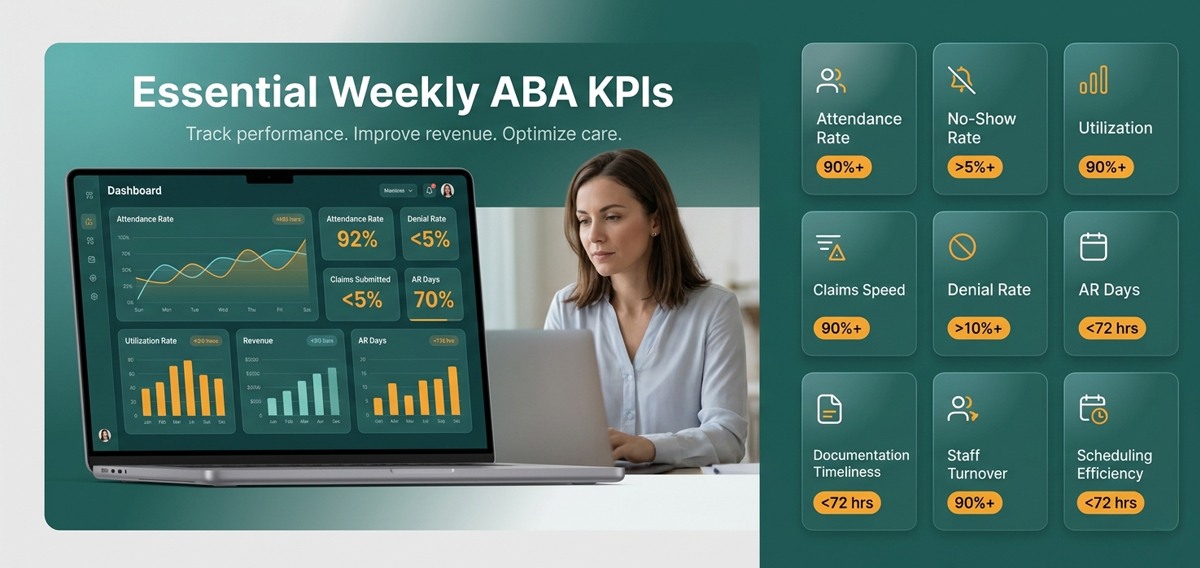
Essential Weekly KPIs Every ABA Practice Should Track
1. Client Attendance Rate
The formula is:
Sessions that were finished ÷ Sessions that were planned
Why it matters: It’s directly related to money.
- 85% to 95% is the benchmark.
Advice:
- Set up automatic reminders
- Make it easier for parents to talk to each other
2. Cancellation & No-Show Rate
- Cancellation: Patient informs in advance
- No-show: Patient doesn’t show up
Impact: Lost revenue + wasted staff time
Fix:
- SMS reminders
- Clear cancellation policies
3. Billable vs Non-Billable Hours
Tracks how much time generates revenue.
Ideal Utilization: 65-75%
Common issue: Excess admin work reducing billable time
4. Therapist Utilization Rate
Formula:
Billable Hours ÷ Total Available Hours
Why it matters: Direct impact on profitability
Optimization:
- Smart scheduling
- Reduce gaps between sessions
5. Authorization Utilization Rate
Tracks:
- Approved hours vs used hours
Risk: Unused authorizations = lost revenue
6. Claims Submission Rate (Weekly)
Measures how quickly claims are submitted after sessions.
Ideal timeline: Within 48-72 hours
Impact: Faster cash flow
7. Claim Denial Rate
Tracks percentage of denied claims.
Common reasons:
- Missing documentation
- Authorization errors
Goal: <5%
8. Days in Accounts Receivable (AR)
Tracks how long it takes to collect payments.
Healthy range: 30-45 days
Weekly monitoring helps prevent backlog.
9. Revenue Collected vs Revenue Billed
Measures collection efficiency.
Goal: 90%+ collection rate
10. Staff Turnover Rate
Weekly tracking identifies early warning signs.
Impact:
- Disrupted care
- Higher hiring costs
11. Session Completion Rate
Formula:
Completed Sessions ÷ Scheduled Sessions
Identifies operational bottlenecks.
12. Treatment Plan Progress
Measures patient progress against goals.
Ensures therapy is effective and data-driven.
13. Scheduling Efficiency Rate
Identifies gaps and idle time.
Goal: Minimize downtime between sessions
14. Intake to Service Start Time
Measures how fast new clients begin therapy.
Impact: Growth + patient satisfaction
15. Compliance KPI (Documentation Timeliness)
Tracks how quickly session notes are completed.
Goal: Within 24 hours
Ensures audit readiness and clean billing.
KPI Benchmarks for ABA Practices (2026 Standards)
KPI | Good Benchmark | Red Flag |
Attendance Rate | 90% | <80% |
No-Show Rate | <5% | >10% |
Utilization Rate | 70% | <60% |
Claims Submission | <72 hrs | >5 days |
Denial Rate | <5% | >10% |
AR Days | 30–45 | >60 |
Collection Rate | >90% | <80% |
Documentation Timeliness | <24 hrs | >48 hrs |
Use this table to evaluate your current performance.
Common Mistakes ABA Practices Make
- Tracking too many metrics
- Reviewing data monthly instead of weekly
- Relying on manual spreadsheets
- Ignoring insights instead of acting on them
The biggest mistake?
Collecting data without making decisions.
How to Set Up a Weekly KPI Dashboard?
Manual vs Automated
- Manual: Spreadsheets (time-consuming, error-prone)
- Automated: Integrated systems (recommended)
A Good Dashboard Includes:
- Real-time data
- Visual charts
- Alerts for red flags
- Role-based insights
Workflow Example:
Every Monday:
- Review KPIs
- Identify gaps
- Assign corrective actions
How Technology Can Automate KPI Tracking?
Modern ABA practices are moving toward connected platforms that combine:
- Setting up
- Tracking sessions
- Managing authorizations
- Analytics for billing
This gets rid of the need for manual coordination and lets you see things in real time.
Platforms like Caretap ABA practice management software are designed to:
- Automatically track authorizations
- Convert sessions into billing workflows
- Provide dashboards for operational and clinical insights
The result:
- Faster decisions
- Reduced administrative workload
- Better performance tracking
Weekly KPI Review Checklist
Every Monday, use this:
- Look over the rates of attendance and no-shows
- Check how much the therapist is used
- Check that authorization is being used
- Make sure claims are sent in on time.
- Look at trends in denial
- Keep an eye on AR days
- Check that the paperwork is done
- Look at gaps in the schedule
- Keep an eye on how the patient is doing
Then do something right away.
Conclusion: Turning Data into Growth
It’s not just about numbers when you track KPIs.
It’s all about having control.
When you keep track of the right ABA practice KPIs every week, you get:
- Better results in the clinic
- Payments that are faster
- More efficient operations
The practices that work in 2026 will be the ones that:
- Do it quickly
- Use data all the time
- Keep optimizing
Begin keeping track of your KPIs right now.
Think about using a connected platform that puts all your data in one place if you want to make everything easier, from scheduling to billing to analytics.
Better data doesn’t just help you make decisions; it also helps your business grow.

How to Scale an ABA Practice Without Chaos | Caretap
April 22, 2026[…] 6. Track the Right KPIs Weekly […]