

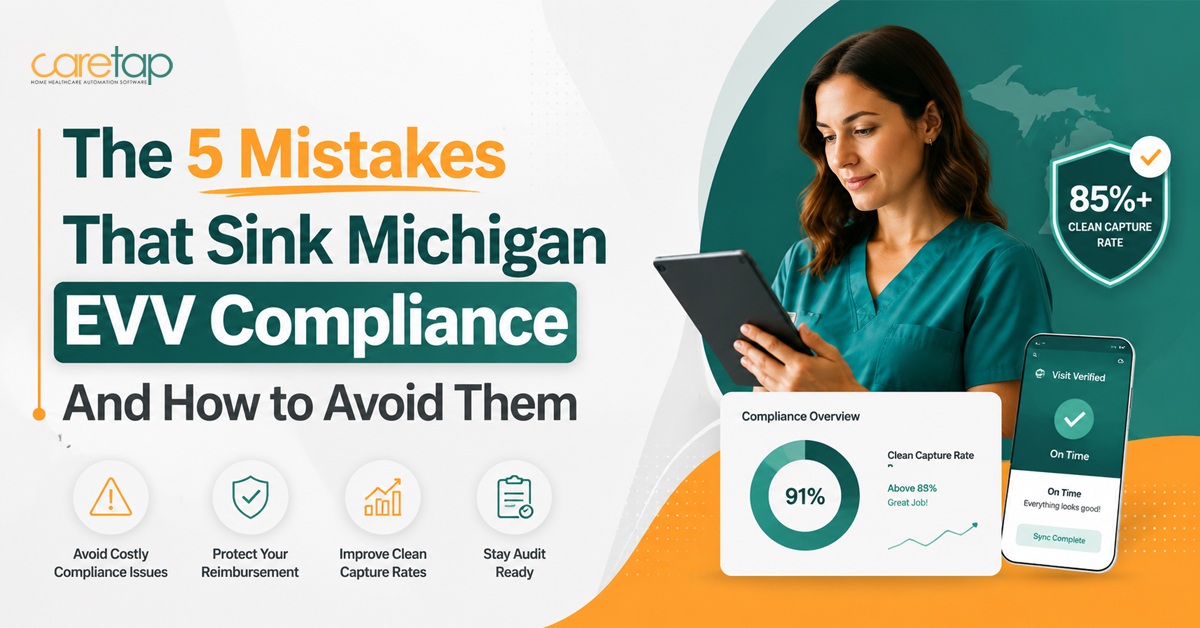

Imagine your quarterly compliance report lands, and your agency-wide clean-capture rate looks solid at 91%. You breathe easy. Then you notice the payer breakdown: one managed care plan accounts for 78%. That’s a formal compliance plan, required retraining, and a review meeting, triggered by a number you never even looked at.
This is happening to Michigan home care agencies right now, and it has nothing to do with the quality of care being delivered.
Since April 1, 2026, MDHHS Bulletin MMP 26-10 has required that at least 85% of verified visits be captured with zero manual edits, measured separately by payer every quarter. Miss it with even one plan, and you’re looking at retraining, a compliance plan, a review meeting, and payments held up while you sort it out.
Here’s the uncomfortable truth most administrators don’t discover until it’s too late: agencies rarely miss 85% due to bad software. They miss it because of how the rollout was managed, the habits at the point of care, and whether anyone was watching the number before the quarter closed.
We looked at what separates agencies that comfortably clear 85% from those that end up in a compliance plan. It comes down to five specific mistakes. Fix them, and the rate takes care of itself.
First: What You’re Actually Being Measured On
Before the five mistakes, three facts you need to have straight:
- The formula is simple. Verified visits with no manual edits ÷ total verified visits = your clean-capture rate. Calculated per payer, per quarter.
- There’s no averaging your way out of it. Bill Medicaid fee-for-service plus two managed care plans? You need 85% on each of the three independently. A great blended number can be hiding a payer that’s failing.
- You get monthly warnings; take them. HHAeXchange sends a Compliance Report every month, to you and to the payer. The quarter closes and gets formally reviewed after: April–June is judged in July, July-September in October.
One more thing worth knowing up front: this metric has nothing to do with the quality of care. It only measures how cleanly a visit was captured. That’s actually good news. It means the fix is entirely within your control.
The Seven Things That Count Against You
A “manual edit” is any fix made because a visit wasn’t captured cleanly the first time. Under MMP 26-10, you lose points for:
- A missing clock-in
- A missing clock-out
- Both missing
- A missing caregiver
- A missing phone number (IVR visits)
- Missing GPS (mobile app visits)
- Any manual change to a time the system already recorded
You’re allowed some edits. MDHHS just wants them rare, never routine. Run the math on a 1,000-visit quarter, and you get roughly 150 edits before you drop below 85%, about 11 a week. Don’t aim to hit that ceiling. Aim to stay nowhere near it.
Now here’s where that budget disappears fastest.
Mistake 1: You Launched EVV Like an IT Rollout, Not a Habit Change
Most agencies treat go-live as the finish line: system’s installed, training email went out, done. But the software was never the hard part. The hard part is ensuring that every caregiver, on every visit, clocks in cleanly without your office having to fix it later.
A caregiver who doesn’t understand why EVV matters or isn’t confident using the app will capture visits sloppily. Multiply that by your whole roster, and your office spends the entire quarter cleaning up edits you can’t fully undo.
Fix it before it costs you:
- Tell caregivers what’s changing before launch, not the week of
- Run hands-on training on clean clock-in/out, and explain what’s actually at stake
- Pilot with a small group first so you catch problems before they hit your whole roster
Mistake 2: You Only Check Your Rate When the Report Arrives
By the time the quarterly Compliance Report lands, the quarter is closed. The number is final. There’s nothing left to do but explain it.
A rate that slips to 82% in week six is an easy fix in week seven; a caregiver needs a quick correction, maybe two. That same slip, discovered in the July or October report, is a compliance plan.
Fix it before it costs you:
- Pull the clean-capture rate weekly, by payer; the agency average tells you almost nothing.
- The moment you see drift, find out which caregivers or offices are driving it.
- Edits cluster. A short, targeted coaching conversation usually fixes more than retraining everyone.
Mistake 3: You’re Managing to the Average, Not the Payer
This is the one that catches agencies who think they’re safe. A 91% agency-wide rate feels comfortable until you realize 85% is scored per payer, and that comfortable average is masking one plan at 78%.
That single payer triggers corrective action regardless of how good everything else looks.
Fix it before it costs you:
- Break every report down by payer, and confirm each one clears 85% with room to spare
- Watch your lower-volume payers especially closely, a few edits swing their percentage fast
- Treat anything under 90% as a warning sign, not a passing grade
Mistake 4: You Assumed the App Logged It, So You’re Covered
Here’s a gap that even careful agencies miss: a visit can be captured perfectly on a caregiver’s phone and still count for zero if HHAeXchange rejects it. Captured is not the same as received, and agencies that assume otherwise find out only when the report shows a hole they can’t explain.
Offline visits add another trap: without a signal, the visit must sync to HHAeXchange within 7 calendar days, or it won’t count at all.
Fix it before it costs you:
- Confirm captured visits were actually accepted at HHAeXchange, not just logged on the device
- Check that offline visits synced within the 7-day window
- Reconcile verified visits against billed visits so nothing disappears quietly between the two
Schedule → capture → transmit → reconcile. It’s one chain, and a break at any link shows up as either a manual edit or a lost visit.
Mistake 5: You Let a Live-In Attestation Expire Without Noticing
Live-in caregivers can be exempt from EVV, but only with a current, approved BPHASA-2421 attestation on file. Let that attestation lapse, and those caregivers fall straight back into your denominator. Nobody in the office notices until the report shows the drop.
There’s a second layer here: live-in caregivers who aren’t properly exempt tend to reconstruct visits from memory after the fact, which generates more manual edits than almost any other source.
Fix it before it costs you:
- File the BPHASA-2421 for every eligible live-in caregiver, and diary the renewal.
- Check attestation status before every quarterly review, not after.
- For anyone not exempt, build a daily, in-the-moment logging habit rather than after-the-fact reconstruction.
Want to stay ahead of Michigan's 85% EVV requirement?
Download the FREE Michigan EVV Compliance Playbook and learn the proven strategies top-performing agencies use to reduce manual edits and maintain compliance.
Why All Five Come Back to the Same Root Cause?
Notice the pattern: not one of these is a technology failure. Every one is something nobody was watching closely enough, soon enough.
A habit you never trained. A rate you only checked at quarter-end. A payer you never isolated. A visit you assumed had transmitted. An attestation you forgot was expiring.
The agencies that comfortably clear 85% aren’t using better software than everyone else. They’re catching their number early, per payer, while there’s still time in the quarter to act on it.
The Offensive Playbook: Stop Edits Before They Happen
Fixing the five mistakes keeps you out of trouble. These three moves go further; they remove the reason an edit gets created in the first place:
- Push the schedule to the caregiver’s phone before the shift. Clocking in against a known appointment is one tap. Filling in a blank form from memory is where most missing-time edits are born.
- Verify the client’s address and GPS before the visit, not after. A clean location on file means a clean match at the door, rather than a manual fix later.
- Decide on live-in caregivers deliberately. Log daily, or file and renew the attestation. Don’t let it sit in a drawer.
Layer in weekly habits: capture at the door, check the rate per payer, confirm transmissions have landed, flag a forgotten clock-out in real time, and coach the handful of caregivers who generate most of your edits.
Want to simplify Michigan EVV compliance?
Click here to explore Caretap’s FREE Michigan EVV Software and see how it helps agencies stay above the 85% compliance threshold with real-time monitoring, caregiver-friendly EVV, and white-glove onboarding.
What This Looks Like Done Right: 98%, Not 85%?
Forever Life Home Care didn’t scrape by at 85%; they held 98% across all payers. Their approach was the inverse of all five mistakes: they told caregivers what was coming before launch, ran in-person training, piloted with a small group first, and reviewed visits weekly to catch problems while they were still cheap to fix.
Their result isn’t a fluke. It’s what happens when communication, training, and weekly follow-up replace “install the app and hope.”
The Fastest Way to Fix All Five at Once
Every mistake above is really the same problem: nobody caught it early enough. That’s not a caregiver problem or a paperwork problem; it’s a visibility problem, and it’s the exact one Caretap was built to close.
EVV is free with Caretap, always $0, on the same open vendor model Michigan already uses. You get white-glove onboarding, hands-on caregiver training built into launch, and weekly clean-capture monitoring broken out per payer, so drift gets caught while the quarter is still open to fix, not after the report closes it for you.
12,000+ caregivers capture visits on Caretap every day. Last year, we billed $460M in claims for agencies who never had to explain a missed 85% to a payer.