


Here’s how a typical rollout goes: an agency licenses an EVV system, sets a launch date, sends every caregiver a login, and considers the job done.
A month or two later, someone pulls up the HHAeXchange Compliance Report and sees a clean-capture rate stuck below 85%. Nobody can figure out why the platform is functioning properly, exactly as the vendor said it would.
That’s the trap. The technology was never the real variable. What decides your Michigan EVV compliance rate isn’t anything that happens inside your platform; it’s what happens at the client’s front door, dozens of times a day, when a caregiver either clocks in the right way or doesn’t. That’s not a feature you configure. It’s a routine your staff either build or skip.
Approach EVV compliance like an IT rollout, and you’ll get a working system with a compliance score that doesn’t budge. Approach it as a habit-building effort among your caregiving staff, and the numbers move on their own. That distinction is everything under Michigan’s current EVV framework, as outlined in MDHHS Bulletin MMP 26-10.
What the 85% rule actually measures?
Since April 1, 2026, Michigan has required agency and FI/FMS providers to keep at least 85% of verified visits free of manual edits, every quarter, measured separately for each payer. The formula is blunt: verified visits with no manual edits ÷ total verified visits.
Read that closely and you’ll notice what it does not measure. It doesn’t measure the quality of care delivered. It doesn’t measure whether your software is good. It measures one thing: how cleanly each visit was captured at the source. And “the source” is a person — a caregiver, standing at a client’s door, deciding whether to clock in properly or fix it later from memory.
A manual edit is any correction made because a visit was captured incompletely or incorrectly. Under MMP 26-10, seven of them count against your rate: a missing clock-in, a missing clock-out, both missing together, a missing caregiver, a missing phone number when IVR is used, missing GPS when the mobile app is used, and manually changing a time the system already logged.
Every one of those is a behavior outcome, not a software outcome. The app didn’t forget to clock out — a person did. Which means the lever that moves your 85% isn’t a setting you configure once. It’s a habit your team keeps every day.
Struggling to Stay Above Michigan's 85% EVV Threshold?
Click Here to Download our free Michigan 85% EVV Compliance Playbook and discover the proven habits, workflows, and weekly processes high-performing agencies use to reduce manual edits and stay compliant.
The Hidden Cost of Treating EVV Like a Tech Rollout
Agencies that lean on an install-it-and-forget-it approach tend to run into the same sequence of problems:
- They mistake go-live for the finish line. In practice, go-live is where the real work starts; everything that actually determines the compliance number happens after the switch gets flipped.
- Staff get logins, not context. A caregiver handed access with zero explanation of what’s riding on it will capture visits inconsistently, then try to patch the gaps from memory, which only manufactures more corrections.
- Front-office teams become full-time fixers. Rather than stopping bad captures at the source, staff spend the quarter cleaning up after them. The problem: cleanup itself is a correction, and every correction eats into the 85%.
- Trouble shows up only after it’s too late to matter. A software launch gets evaluated on day one. Compliance gets evaluated at the close of the quarter, by which point the number is locked in.
Do the math on a typical quarter, and the margin is tight: at 1,000 visits, roughly 150 corrections, about 11 per week is the exact line between meeting and missing 85%. Agencies stuck in reactive cleanup mode burn through that margin fast. Agencies focused on prevention rarely get close to it.
Four Habits That Separate High-Compliance Agencies
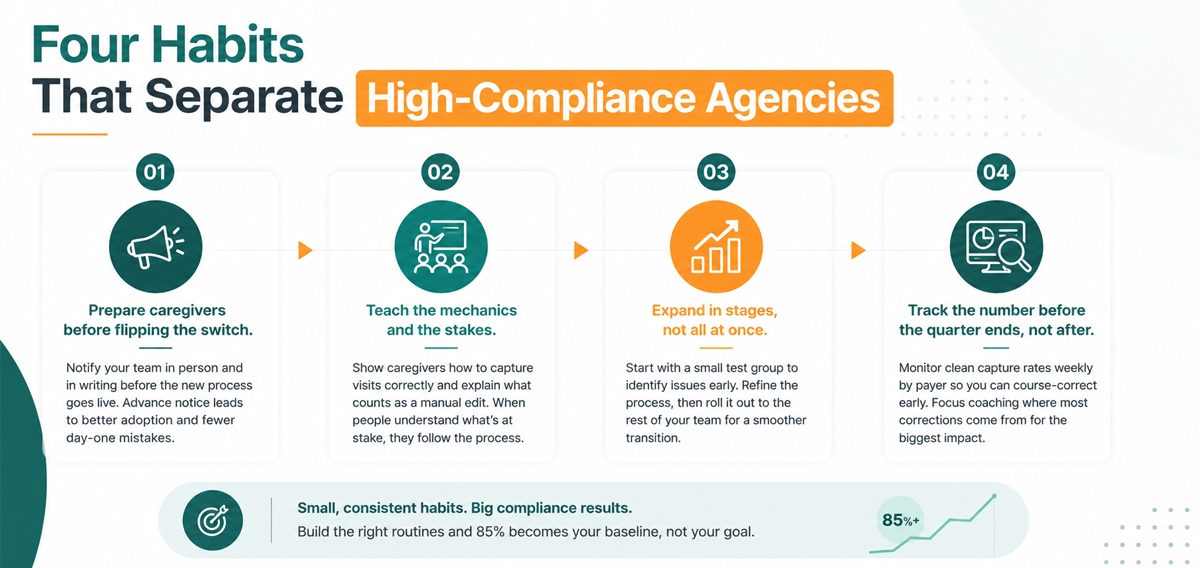
Prepare caregivers before flipping the switch.
Adoption happens when people know what’s coming. Notify your team in person and in writing before the new process goes live, not the day it does. A caregiver caught off guard will guess their way through it. One who’s had advance notice will follow the process correctly from day one.
Teach the mechanics and the stakes.
Getting a login isn’t the same as knowing how to use it well. Show caregivers exactly what a clean clock-in and clock-out look like, how GPS capture works at the door, and what actually counts as a correction. Then go further: explain that dropping below 85% on a payer can mean mandatory retraining, a corrective action plan, a formal compliance review, or delayed reimbursement. People follow a process once they understand what’s at stake, not because a memo told them to.
Expand in stages, not all at once.
Flip your entire caregiver roster over on the same day, and every hiccup becomes a crisis. Start with a small test group instead. Let them surface the confusing screens and location mismatches while the group is small enough to fix quickly, then roll the refined process out to everyone else.
Track the number before the quarter ends, not after.
Waiting for the official report means waiting for information you can no longer act on. Check the clean capture rate weekly, broken out by payer, while there’s still time to course-correct. And since corrections rarely spread evenly, a handful of caregivers usually account for most of them, target coaching there first for the fastest improvement.
Why the Capture Process Runs on People, Not Code?
Every compliant visit runs through four links: schedule → capture → transmit → reconcile. The visit is on the caregiver’s phone before the shift; they clock in cleanly with GPS at the door; the visit syncs to HHAeXchange within 7 calendar days; and someone confirms it was accepted and billed.
An IT-project mindset assumes the software handles all four automatically. It doesn’t. A caregiver has to use the schedule. A caregiver has to capture cleanly. Offline visits only count if the behavior around syncing happens within 7 days. And “captured” is not “received” — a perfectly captured visit rejected at HHAeXchange still counts as zero, so someone has to reconcile transmissions against your own records rather than assume they landed.
A break anywhere in that chain shows up as a manual edit or a lost visit. Agencies that stay above 85% treat all four links as one human process — not four things the software does for
Red Flags That Your EVV Program Is Stuck in “Install Mode”
If more than a couple of these describe your agency, you’re running a software deployment instead of a compliance program:
- Launch day was treated as a deadline, not the start of ongoing training
- Caregivers got system access with no explanation of the “why”
- Corrections get cleaned up after visits happen, instead of prevented beforehand
- The compliance rate only gets a look once the quarterly report arrives
- You’re tracking one overall average instead of breaking it out by payer
- Nobody’s confirming that captured visits actually made it into HHAeXchange
- Live-in caregiver BPHASA-2421 renewals have no clear owner
Every item on that list is a gap in visibility or routine, not a limitation of your technology. That also means every one is fixable without switching vendors.
Real Results: How One Agency Reached 98%
Forever Life Home Care didn’t settle for clearing the 85% bar; they maintained a 98% clean-capture rate across all payers by placing the same weight on adoption as most agencies put on installation.
Ahead of their rollout, they sent letters, emails, and printed materials explaining exactly what was changing and what caregivers would need to do differently. They followed that with in-person training covering the app itself, proper clock-in and clock-out procedure, and the real consequences of skipping steps. Instead of switching every caregiver over on day one, they piloted the process with a smaller group first, worked out the rough edges, and only then rolled it out agency-wide. Once live, they reviewed visit data every week, chased down anything incomplete right away, and kept unnecessary corrections to a minimum.
The lesson isn’t complicated: a login doesn’t create compliance. Advance communication, real training, a phased rollout, and constant follow-up do. Waiting for a quarterly report to flag a problem means finding out too late to fix it; weekly checks and quick corrections are what make EVV a habit rather than a recurring surprise.
A Practical Sequence for Getting There
If you’re setting up or resetting your EVV process in Michigan, work through it in this order:
- Handle the setup, but don’t confuse it with success. Finish HHAeXchange enrollment (you’ll need an active NPI and CHAMPS registration), decide how visits will be captured through HHAeXchange’s own tools or your platform via EDI and submit the Third Party EVV Attestation if applicable.
- Give caregivers notice before anything changes. Explain what’s coming, why it matters, and what’s expected of them.
- Train in person and explain the consequences. Make in-app, at-the-door capture the standard method; reserve phone-based and manual fixes for genuine exceptions.
- Test with a small group before scaling. Fix what breaks while the group is small, then expand a proven process.
- Send the schedule to each caregiver ahead of every shift. When the appointment’s already loaded, checking in becomes a single tap against a known visit, which prevents most missing- or wrong-time corrections before they can happen.
- Confirm client addresses and locations in advance. Accurate location data means the GPS match works cleanly at the door, avoiding the need for a location-based correction later.
- Review compliance weekly, by payer, and coach the outliers. Track the number as the quarter progresses, reconcile every transmission, and focus your coaching effort where corrections are most needed.
- Handle live-in caregivers with a specific plan. Either establish a consistent daily logging routine or file and keep the BPHASA-2421 exemption current so those visits don’t count toward your rate at all.
And if you’re new to EVV or recently changed systems, use the grace period. It applies to newly enrolled providers, new programs, and new implementations, running from the quarter the change takes effect through the following full quarter a built-in window for building the right habits before they’re being scored.
What to Actually Look for in an EVV Vendor?
If compliance really comes down to caregiver behavior, the most useful thing a vendor can offer isn’t another dashboard; it’s a team that helps build those habits alongside you. A support ticket won’t change how someone clocks in at the door. A team with hundreds of successful agency rollouts behind them will.
That’s the approach behind Caretap Michigan EVV Software: onboarding handled hands-on HHAeXchange enrollment, EDI setup, and third-party attestations managed together with your team; direct caregiver training focused on clean capture at the point of care, and weekly per-payer monitoring that catches slipping numbers early, while there’s still time in the quarter to fix them. Staying compliant isn’t a toggle you flip once; it’s an ongoing routine a team maintains with you, payer by payer, quarter after quarter. Caretap currently supports more than 12,000 caregivers capturing visits on the platform, and agencies using it billed $460M in claims last year.

Best Home Care Software for Michigan Agencies in 2026: What to Look For | Caretap
August 5, 2026[…] A caregiver opening a blank form and typing a time is generating an edit. A caregiver tapping once against a visit already sitting on their phone — GPS and signature attached — isn’t. That’s the entire difference, and it’s why we argue EVV is a behavior-change program, not an IT project. […]
Best Home Care Software for Michigan Agencies in 2026: Buyer's Guide
August 5, 2026[…] A caregiver opening a blank form and typing a time is generating an edit. A caregiver tapping once against a visit already sitting on their phone — GPS and signature attached — isn’t. That’s the entire difference, and it’s why we argue EVV is a behavior-change program, not an IT project. […]