

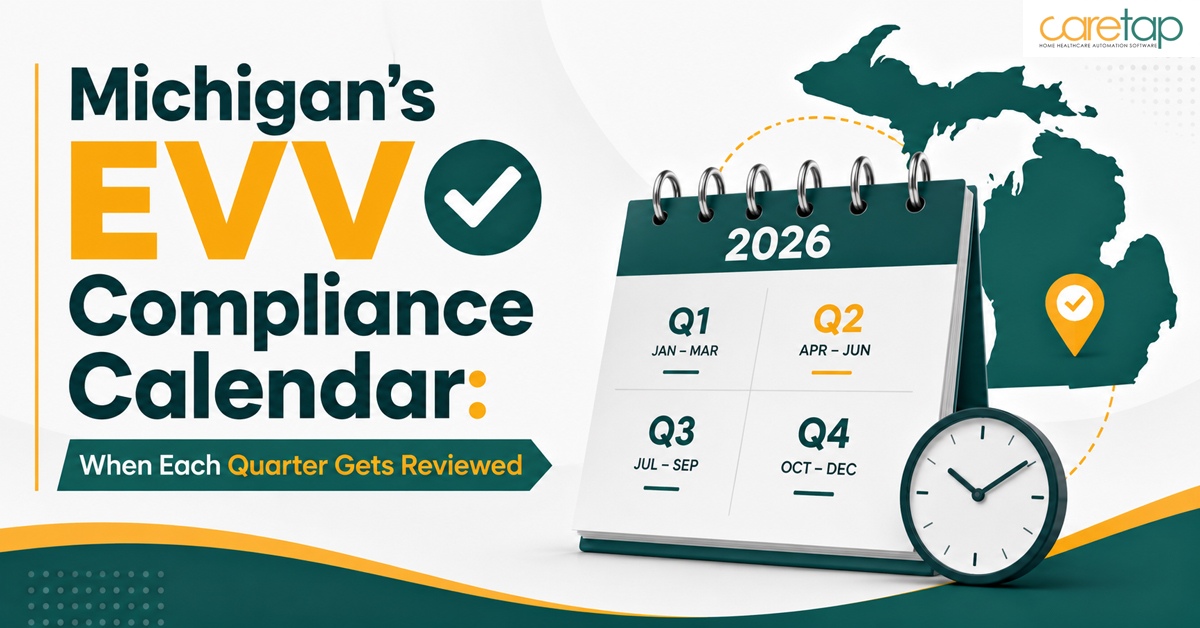

Most compliance deadlines work the way you’d expect: a date shows up on the calendar, you scramble a little beforehand, you hit it, or you don’t. Michigan’s EVV rule doesn’t work that way, and that difference is exactly what’s catching home care and ABA agencies off guard right now.
Quick context if you’re new to this: EVV stands for Electronic Visit Verification, the system that electronically confirms when, where, and by whom a home care or behavioral health visit actually happened, instead of relying on paper timesheets.
Here’s the twist with Michigan’s version of it. The state doesn’t review your quarter until after it’s already closed. Your compliance number for April through June is determined by three months of daily caregiver visits, and you don’t find out the verdict until the quarter is history and there’s nothing left to change.
Agencies that stay in good standing aren’t the ones who scramble at the finish line. They’re the ones who’ve internalized the calendar and manage their numbers week by week, while the quarter is still open. Below is exactly how that calendar works, where it came from, when each quarter gets scored, the two dates that already changed your cash flow, and a practical plan for staying ahead of it.
How Michigan's EVV Rule Came Together?
EVV in Michigan isn’t a new idea that appeared overnight; it’s the tail end of a multi-year rollout tied back to the 21st Century Cures Act of 2016, the federal law that required every state to electronically verify Medicaid personal care and home health visits. Michigan built its rollout around HHAeXchange as the state’s EVV vendor and aggregator, using an open-vendor model, and phased in different provider types over time rather than flipping one switch for everyone.
The timeline looked roughly like this:
Date | What Happened |
April 1, 2024 | EVV goes live for Home Health Fee-for-Service, the first program on HHAeXchange |
June 1, 2024 | Hard cutover for FFS home health; everything routes through HHAeXchange |
July 1, 2024 | Home Help agency providers go live |
September 3-9, 2024 | Home Help individual providers, MI Choice, MI Health Link, Medicaid managed care plans, and Behavioral Health all come online |
December 31, 2025 | Managed care home health soft-launch period ends |
January 1, 2026 | Hard cutover for managed care home health services |
April 1, 2026 | Enforcement and threshold monitoring begin under MMP 26-10 |
For nearly three years, the state’s focus was simply getting everyone onto the system. April 1, 2026 is when it shifted from “are you using this” to “how well are you using it.”
The Rule Itself: 85%, Every Quarter, Per Payer
As of April 1, 2026, MDHHS Bulletin MMP 26-10 requires that at least 85% of your verified visits each quarter be captured cleanly, with no manual edits. The part that trips people up: it’s not one blended agency-wide score. Fee-for-service and every managed care plan you bill are scored separately.
That distinction matters more than most agencies expect. A strong overall average can still hide one small payer quietly failing underneath it, which is worth its own conversation if you haven’t looked closely at how per-payer scoring actually works.
When Each Quarter Actually Gets Reviewed?
HHAeXchange continuously builds your clean-capture data, and monthly reports accumulate over time. But the 85% threshold is judged against the full calendar quarter, and the official review only happens once that quarter is sealed shut.
Quarter | Months covered | Reviewed in |
Q1 | January – March | April |
Q2 | April – June | July |
Q3 | July – September | October |
Q4 | October – December | January |
Notice the lag. Your Q2 performance isn’t judged in June; it’s judged in July, a full month after the quarter you’re being scored on has already ended. That pattern repeats every quarter, all year.
The monthly reports inside HHAeXchange exist precisely to close that gap. Agencies that check them treat every month like a checkpoint. Agencies that skip them find out their Q2 result in July, by which point Q2 is already gone.
Why the Timing Is the Real Trap?
Put the two facts side by side, and the problem is obvious:
- Your rate is set by what caregivers do, every day, for three straight months.
- The official review only happens after that window closes.
Which means the exact moment you learn your score is the exact moment you’ve lost any ability to change it. If a payer closes the quarter at 82%, there’s no visit to re-capture, no edit to undo, no caregiver to retrain retroactively. The number is locked, and the corrective action follows it.
That’s why “we’ll check compliance at quarter-end” is a strategy that only feels safe. Quarter-end isn’t a check-up; it’s deep research. The real check-up has to happen while the quarter is still live: ideally every week, broken out by payer, so a plan drifting toward 85% in week six can still be pulled back before week thirteen closes the book.
Two Dates Already Quietly Changed How You Get Paid
The April 1 enforcement date gets most of the attention, but two earlier dates rewired agency cash flow before anyone was watching, and both are already in effect.
January 1, 2026, marks the hard cutover for managed care. From this date forward, managed care home health services requiring EVV must run through the state’s EVV system. Direct claims to the health plan get denied outright. Worse for cash flow: the state won’t generate a claim at all until the EVV record is complete. Without a clean visit record, there is no claim and no payment.
April 1, 2026, enforcement and threshold monitoring. This date is when the 85% quarterly, per-payer scoring became real, with corrective action plans, mandatory retraining, added oversight, and delayed reimbursement all on the table for any payer that comes up short.
Together, these two dates mean EVV stopped being a documentation formality. It’s now directly tied to whether and when money actually lands in your account.
Where Things Stand Right Now?
Here’s what makes this timely rather than theoretical: enforcement started April 1, 2026, which means Q2 (April-June 2026) was the first quarter that actually counted. And under the calendar above, Q2 is being reviewed right now, in July.
If you were watching your per-payer numbers through the spring, you’re likely in good shape. If you assumed a decent-looking average would carry you, this may be the month you’re having your first corrective-action conversation. Meanwhile, Q3 (July–September) is already underway and what your caregivers capture today will be what October’s review judges.
The takeaway: there’s always a live quarter being scored somewhere. The only real choice is whether you’re watching it while it’s still possible to steer.
One Exception: The New-Provider Grace Period
If you’ve just enrolled as a Michigan Medicaid provider, you get some breathing room. Newly enrolled providers are generally exempt from the 85% threshold for their enrollment quarter and the one immediately after it, time meant for onboarding caregivers and building clean habits before the number starts counting against you. It’s the one stretch where the calendar is actually working in your favor, so it’s worth using deliberately.
Don't Let Manual Edits Cost You Compliance.
See how Caretap Michigan EVV Software helps Michigan agencies track EVV compliance in real time, reduce manual edits, and stay above the 85% threshold.
A Quarter-by-Quarter Plan That Actually Works
Since the quarter is the unit you’re graded on, it helps to break each one into three phases:
Weeks 1- 4: set your baseline. Confirm every active caregiver is capturing cleanly, close out any lingering issues from last quarter, and pull your first per-payer read. Catching a struggling caregiver here gives you the whole quarter to fix the pattern.
Weeks 5-9: watch for drift. This is the window where intervention actually pays off. Check your clean-capture rate by payer every week. A small, low-volume plan can slide below 85% much faster than a large one; a handful of bad visits is enough to sink it, so don’t wait to act. Reconcile rejected and pending visits so “captured” genuinely means “received” by HHAeXchange.
Weeks 10-13: lock it in. Make sure offline visits have synced within the seven-day window, clear out the exception queue, and confirm no payer is sitting on the wrong side of 85%. Whatever gets fixed here still counts. Whatever slips through the locks is permanently in at quarter-end.
Do this consistently, and the quarterly review stops being a surprise; it just confirms what you already knew weeks earlier.
Conclusion
Michigan doesn’t grade you on a due date you can circle in advance. It grades you on a quarter you’ve already finished by the time anyone looks at it. That’s exactly why the calendar itself has to be your strategy: know which quarter is live, track your per-payer rate weekly while it’s still open, and treat your monthly HHAeXchange reports as the early warning they’re designed to be.

Best Home Care Software for Michigan Agencies in 2026: What to Look For | Caretap
August 5, 2026[…] An 82% caught in week six is a coaching conversation with two caregivers. That same 82% discovered in July is a compliance plan. Same number, completely different outcome — which is the whole argument in Michigan’s EVV rule grades you after the quarter ends. […]