



You started your ABA practice to help children and families — not to spend your evenings buried in spreadsheets, chasing authorizations, or fielding calls about missed sessions.
But somewhere between your clinical mission and day-to-day operations, the paperwork took over.
Sound familiar?
You’re not alone. Across the country, ABA clinic owners and practice administrators are hitting the same invisible ceiling. Growth stalls — not because of a lack of demand, not because of a shortage of qualified therapists — but because the systems running the practice weren’t built to scale.
The hard truth: most ABA practices don’t have a clinical problem. They have an operational one.
This post breaks down exactly why ABA practice growth remains elusive for so many — and what high-performing practices are doing differently.
Why Most ABA Practices Struggle to Grow?
1. Disconnected Systems That Create More Work
The average ABA practice runs on a patchwork of tools: one platform for scheduling, another for billing, a separate EHR for documentation, and email for everything else. Each system creates data silos. Each transition between tools creates room for error.
The result? Your staff spends hours every week re-entering the same information across multiple platforms — time that should be spent on patient care or growth.
When your systems don’t talk to each other, your practice can’t move efficiently. And inefficiency has a compounding effect at scale.
2. Administrative Overload Is Eating Your Team Alive
Admin tasks in ABA aren’t just annoying — they’re relentless.
Authorizations need tracking. Session notes need reviewing. Insurance claims need submitting. Scheduling changes need communicating. Every missed step creates a downstream problem, and your admin team is left firefighting instead of building.
As your caseload grows, this burden multiplies. More clients means more authorizations, more notes, more claims, more coordination — and without the right infrastructure, growth becomes something your team dreads, not celebrates.
3. Scheduling Inefficiencies That Cost You Revenue Every Day
Therapist utilization is one of the most important metrics in any ABA practice — and one of the most overlooked.
Every unfilled appointment slot, every scheduling conflict, every last-minute cancellation that doesn’t get backfilled represents direct lost revenue. For a practice with 20+ therapists, even a 10% drop in utilization can translate to tens of thousands of dollars annually.
Manual scheduling — whether in spreadsheets or basic calendar tools — simply can’t optimize across variables like therapist availability, client authorization hours, travel time, and caseload balance. Gaps happen. Revenue walks out the door.
4. Billing Delays and Revenue Leakage
ABA billing is uniquely complex. Insurance requirements vary. Authorization windows expire. Codes get rejected for tiny documentation errors. And every denied claim that isn’t followed up on becomes revenue you’ll never recover.
For most practices, billing delays aren’t occasional — they’re structural. Claims go out late. Denials pile up. Cash flow becomes unpredictable. And by the time you’re tracking down a rejection from 60 days ago, the window to appeal has often closed.
Revenue leakage in ABA is quiet. It doesn’t announce itself. It just shows up as a gap between what your practice should be earning and what actually hits your account.
Still losing revenue to denied claims and billing delays?
See how Caretap helps ABA practices streamline billing workflows, reduce claim rejections, and improve cash flow with smarter automation.
5. No Real-Time Visibility Into What's Actually Happening
If you can’t see what’s happening in your practice right now, you can’t make good decisions for tomorrow.
Most ABA practice owners are running on lagging indicators — last month’s billing report, last week’s session counts, a gut feeling about which therapists are overwhelmed. By the time the data surfaces, the problem has already grown.
Without real-time insights into utilization, authorization usage, billing status, and clinical outcomes, growth planning becomes guesswork.
The Hidden Cost of Inefficiency
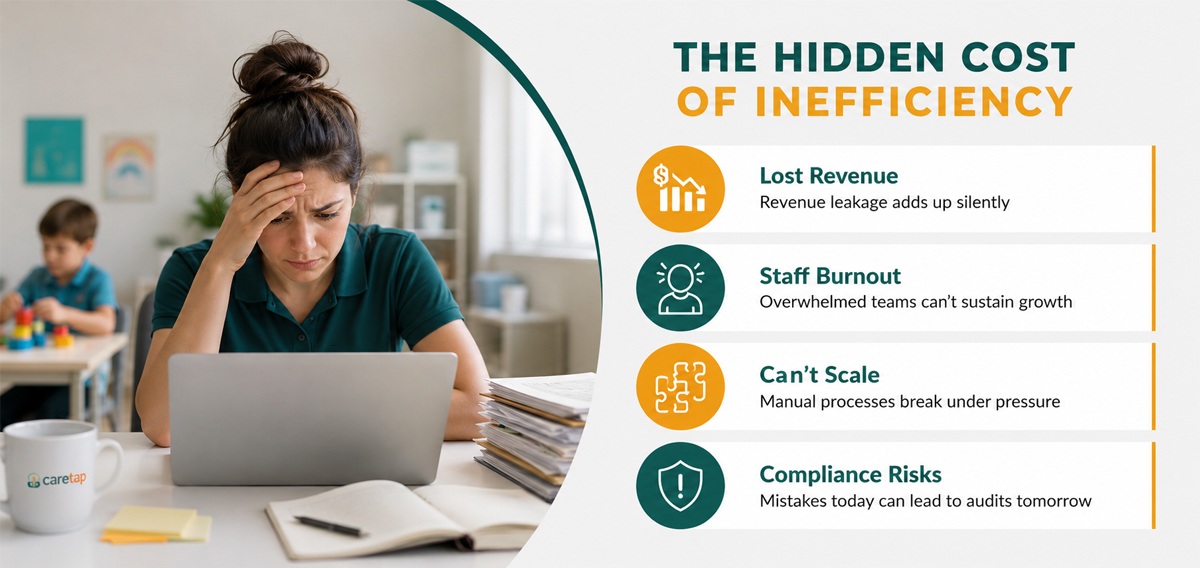
The operational drag described above isn’t just inconvenient — it carries serious financial and organizational consequences.
Lost Revenue You Don't Even Know About
Between unfilled slots, unbilled sessions, expired authorizations, and denied claims that never get appealed, the average ABA practice leaks more revenue than it realizes. These aren’t dramatic failures — they’re small, consistent losses that accumulate silently over time.
Staff Burnout at Every Level
Therapists entered this field to work with clients — not to wrestle with paperwork. When clinical staff are burdened with documentation friction and scheduling chaos, morale drops. Burnout follows. And in a field already facing workforce shortages, losing a good therapist to burnout isn’t just an HR problem — it’s a growth constraint.
The same applies to your admin team. If they’re spending their days on data entry and claims rework, they don’t have capacity to support expansion.
Scalability Becomes Structurally Impossible
Here’s the painful irony: the practices that need efficient systems most are the ones trying to grow. But manual processes don’t scale. Adding 10 more clients without fixing operational inefficiencies doesn’t grow your practice — it amplifies your problems.
Growth without the right infrastructure doesn’t double your revenue. It doubles your headaches.
Compliance and Authorization Risks
ABA practices operate in a heavily regulated environment. Expired authorizations, incomplete session documentation, and billing errors don’t just cost money — they create compliance exposure. In a worst-case scenario, they trigger audits and put your contracts with payers at risk.
How Modern ABA Practices Are Solving This?
The practices that are scaling successfully aren’t necessarily larger or better funded. They’ve made a different choice: they’ve replaced reactive, manual operations with a connected, data-driven system that runs in the background — and frees their team to focus forward.
They’ve moved from managing chaos to managing outcomes.
The shift comes down to one core decision: investing in purpose-built ABA practice management software that integrates scheduling, documentation, authorization tracking, billing, and analytics into a single, unified workflow.
How Caretap Helps ABA Practices Scale With Confidence?
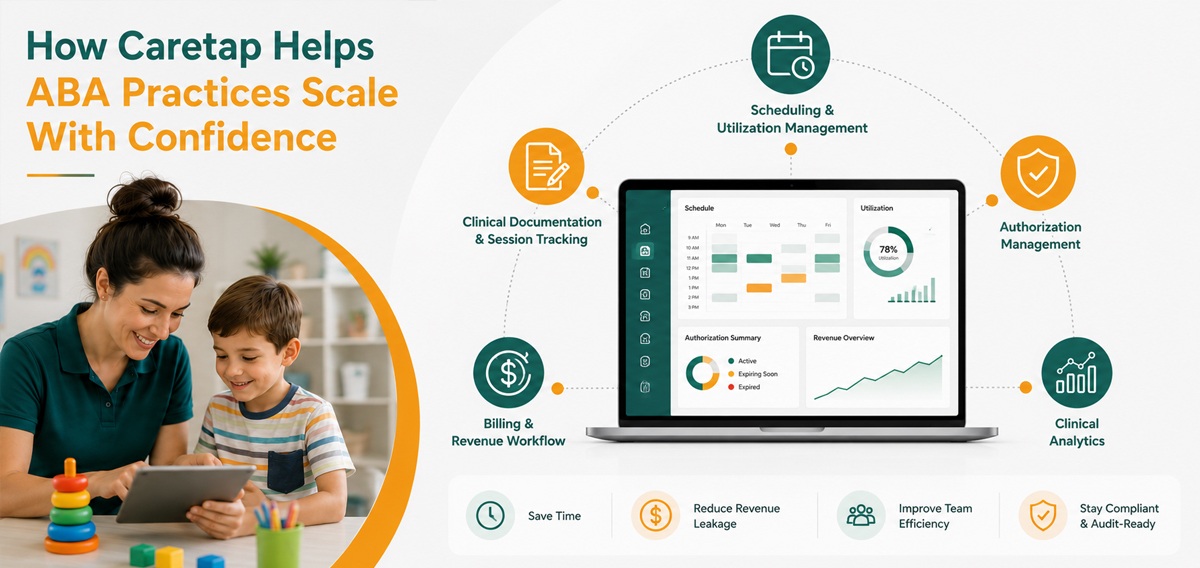
Caretap ABA Software was built specifically for the operational realities of ABA practices. Not generic healthcare software retrofitted for behavioral health — purpose-built for the way ABA clinics actually work.
Here’s how it addresses each of the core challenges holding practices back.
Scheduling & Utilization Management
Therapist time is your most valuable — and most perishable — resource. Caretap’s scheduling tools give practice managers real-time visibility into therapist availability, caseload capacity, and authorization hours, making it possible to fill gaps proactively instead of scrambling reactively.
- Reduce no-shows and last-minute gaps with smart scheduling workflows
- Match clients to available therapists based on skills, availability, and authorization status
- Track utilization rates by therapist, location, or program at a glance
- Eliminate double-bookings and manual coordination across teams
The result: fewer empty slots, better therapist balance, and more billable hours per week — without adding headcount.
Clinical Documentation & Session Tracking
Accurate, timely documentation is the backbone of ABA compliance and billing. Caretap makes it easy for therapists to capture session data in real time — directly from the point of care — reducing end-of-day backlogs and documentation errors.
- Mobile-friendly session notes built for ABA workflows
- Real-time data entry that keeps records current and audit-ready
- Structured templates aligned with clinical and payer requirements
- Supervisor review and sign-off built directly into the workflow
When documentation is accurate and current, everything downstream — billing, reporting, compliance — works better.
Authorization Management
Expired authorizations are one of the most common — and most preventable — sources of revenue loss in ABA. Caretap tracks every authorization: its start date, expiration date, approved hours, and utilization to date.
- Automated alerts before authorizations expire
- Real-time tracking of authorized hours versus hours delivered
- Visibility into unused authorizations before they lapse
- Streamlined renewal workflows that reduce admin burden
No more scrambling to discover that a client’s auth expired three weeks ago. No more unbillable sessions because the paperwork wasn’t in place.
Billing & Revenue Workflow
Caretap connects clinical documentation directly to the billing workflow — reducing the lag between session delivery and claim submission, and minimizing the errors that lead to denials.
- Auto-populated claims from session notes reduce manual entry
- Built-in validation catches common billing errors before submission
- Denial tracking and resubmission workflows that keep revenue moving
- Real-time visibility into claim status across your entire caseload
The impact shows up in your cash flow: faster submissions, fewer rejections, and a shorter gap between service delivery and payment received.
Clinical Analytics
You can’t grow what you can’t measure. Caretap’s analytics give practice owners and clinical directors the real-time data they need to make decisions with confidence — not instinct.
- Utilization dashboards by therapist, program, and location
- Clinical outcome tracking tied to treatment goals
- Revenue and billing performance at a glance
- Caseload and capacity planning tools to support growth decisions
Instead of waiting for month-end reports, your leadership team can see what’s working, what isn’t, and where to focus — today.
Ready to scale your ABA practice without the operational headaches?
Book a free Caretap demo and see how smarter scheduling, streamlined billing, and real-time insights can help your team grow with confidence.
Real Business Impact
Practices using Caretap ABA practice management software report outcomes across three critical dimensions:
Efficiency Gains
- Significant reduction in time spent on scheduling coordination and session documentation
- Admin teams freed from manual data entry and claims rework
- Faster turnaround on authorization management and renewals
Revenue Improvement
- Higher therapist utilization rates through smarter scheduling
- Fewer denied claims and faster resubmission cycles
- Reduced revenue leakage from expired authorizations and unbilled sessions
Reduced Administrative Burden
- Clinical staff spending more time on care, less on paperwork
- Practice managers with real-time visibility instead of lagging reports
- Leadership teams making growth decisions based on data, not guesswork
Conclusion
Growing an ABA practice is one of the most meaningful things you can do in behavioral healthcare. But growth requires more than clinical excellence — it requires operational infrastructure that can carry the weight of expansion without breaking.
The challenges holding most ABA practices back aren’t unsolvable. They’re systemic. And systemic problems need systemic solutions.
Caretap gives ABA practices the connected, purpose-built platform to replace operational chaos with clarity — so your team can stop managing problems and start building something bigger.
The practices that will lead this field in five years aren’t the ones with the most clients today. They’re the ones building the operational foundation to serve them well.