


For nearly six years, Virginia exempted home care aides who lived with the person they cared for from electronic visit verification (EVV). That exemption ended on October 1, 2026. Now, all agency-directed aides providing Medicaid-covered personal care, respite, or companion services must use an approved EVV method to record every visit.
If your agency implemented EVV in 2019 and hasn’t reviewed its setup since, it’s time for an update. This guide explains who must comply with Virginia’s EVV requirements, what information each visit record must include, how EVV data reaches payers, who can correct visit records, and what your agency should review now.
Virginia requires agency-directed providers of Medicaid personal care, respite, and companion services to electronically verify every visit. Each EVV record must capture six required data elements. Agencies must submit this information to the Department of Medical Assistance Services (DMAS) with their claims or through the submission process required by the member’s health plan. Since October 1, 2026, this requirement also applies to live-in aides.
Virginia EVV Requirements at a Glance
Question | Answer for Agency-Directed Providers (November 2026) |
Which services require EVV? | Medicaid personal care, respite, and companion services. Home health has a separate EVV requirement. |
Who chooses the EVV system? | Your agency. DMAS follows an open vendor model. |
What information must each record include? | Service type, member, date, start and end times, location at the beginning and end of the visit, and the aide’s identity. |
Do live-in aides need EVV? | Yes. Every shift must be recorded electronically starting October 1, 2026. |
Who can correct a visit record? | A supervisor, the agency owner, or an authorized designee. Aides cannot correct another worker’s visit times. |
How long must EVV records be kept? | At least six years from the last date of service. |
Who Must Follow Virginia EVV Requirements?
If your agency bills Virginia Medicaid for in-home personal care, respite, or companion services, these EVV requirements apply to you.
The federal requirement comes from Section 12006 of the 21st Century Cures Act. It requires electronic visit verification for Medicaid personal care and home health services that involve an in-home visit. States that fail to comply risk losing part of their federal Medicaid funding. In Virginia, that put nearly $870 million in yearly personal care spending at risk.
Virginia expanded the requirement beyond federal law. Under 12VAC30-60-65, EVV also applies to respite and companion services, and it covers both agency-directed and consumer-directed care.
DMAS follows an open vendor model, which means agencies can choose any EVV system that meets state requirements. In consumer-directed care, the fiscal employer/agent (PPL or Consumer Direct Care Network) manages the EVV system. This guide focuses on agency-directed providers.
Three settings are exempt from Virginia’s EVV requirements:
- DBHDS-licensed program sites, such as group homes and sponsored residential homes
- The REACH crisis program
- Schools providing personal care services under an Individualized Education Program (IEP)
One important detail: the published text of 12VAC30-60-65(C) still lists live-in caregivers as an exempt group. DMAS guidance confirms that this exemption ended on October 1, 2026, so follow the latest DMAS and health plan guidance rather than the older regulation text.
What Changed on October 1, 2026?
Since October 1, 2026, DMAS has required all agency-directed aides and consumer-directed attendants to use an approved EVV method for every shift, even if they live with the person receiving care.
Before this change, agencies could bill exempt live-in shifts without EVV records and instead maintain written documentation.
The change raised concerns among families and caregivers. In response, DMAS issued a letter titled “We Heard Your Concerns,” addressing three important points:
- Occasional mistakes won’t automatically remove caregivers from the program. For example, forgetting to clock out once does not automatically result in removal.
- EVV does not restrict where care can be provided. Caregivers can clock in and out when providing authorized services in the community, not just inside the member’s home.
- No compliance penalties will apply before January 1, 2027.
Agencies should use this transition period to make sure all live-in shifts are properly recorded before penalties begin.
Here are four steps to take:
- Identify all live-in shifts. Some live-in aides may never have used an EVV app, so treat them as new users and provide the necessary training.
- Choose a clock-in method for each home. Caregivers can use a mobile app with GPS enabled or IVR through the home’s landline. For consumer-directed attendants, DMAS considers app-based visits without GPS non-compliant and does not accept web portal entries. Agencies can follow the same approach.
- Confirm billing requirements. Contact DMAS and each health plan to understand how to bill live-in shifts from October 1, 2026.
- Prepare for family questions. DMAS directs agency-employed aides to contact their employer with EVV questions. Make sure your office is ready to help.
What Information Must Every Virginia EVV Record Include?
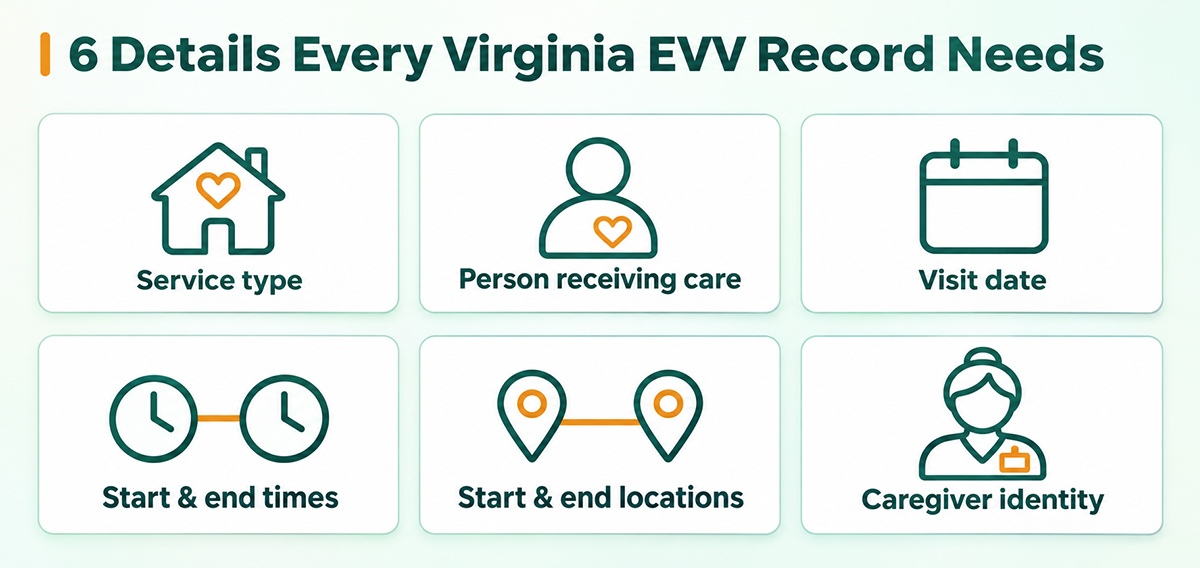
Under 12VAC30-60-65(D), every EVV record must contain six required data elements.
Data Element | What It Means |
Type of service | The service provided, such as personal care, respite, or companion care, matched to the authorization. |
Individual receiving the service | The Medicaid member receiving care. |
Date of service | The month, day, and year of the visit. |
Start and end times | The caregiver’s clock-in and clock-out times. |
Location at start and end | Where the visit began and where it ended. |
Aide providing the service | The identity of the individual caregiver who provided the service. |
Virginia requires location information at both the beginning and end of a visit. However, EVV does not mean caregivers must remain at the member’s home. Authorized services can still take place in the community.
Your EVV system must also meet several operational requirements. It must:
- Capture visit information in real time and provide electronic records when DMAS requests them.
- Remain available 24 hours a day, seven days a week, with at least daily data backups.
- Support multiple shifts per day, caregivers serving multiple clients, multiple caregivers serving one client, and multiple clients living at the same address.
- Meet ADA and HIPAA requirements.
- Send data to DMAS in the required format or integrate with your billing system.
If none of the available EVV methods works at a particular home and a visit must be entered later, keep a written note explaining why EVV could not be used.
Meet Virginia’s EVV Requirements With Caretap Free EVV
How Does EVV Data Reach DMAS and Health Plans?
Recording a visit is only one part of EVV compliance. Agencies must also ensure visit data reaches the correct payer through the required submission process.
For fee-for-service Medicaid members, EVV data must be submitted to DMAS with the billing claim. Since September 1, 2020, DMAS has denied agency-directed claims that fail its EVV requirements.
Members enrolled in Cardinal Care health plans may have additional submission requirements. Each health plan can establish its own process for receiving EVV data.
Humana Healthy Horizons in Virginia is one example.
Agencies can record visits using any EVV vendor. However, all EVV claims for Humana members must be submitted through the HHAeXchange portal.
Claims for dates of service on or after November 1, 2025, submitted through other channels are denied. Your EVV vendor must either be fully integrated with HHAeXchange or you must use Humana’s sponsored HHAeXchange tools.
Before adding a payer or changing EVV systems, contact the health plan’s provider relations team to confirm its submission requirements. Payer requirements can change, and claims submitted through an outdated process may not be paid.
Who Can Correct an EVV Visit Record?
Visit records don’t always capture everything correctly. A caregiver might forget to clock out, a phone might lose power during a shift, or GPS might record a location slightly away from the member’s home.
Virginia allows agencies to correct EVV records, but only certain people can make those changes.
Under 12VAC30-60-65(D)(2), only a supervisor, the agency owner, or an authorized designee with the authority to make independent verifications can correct a visit’s start or end time.
Caregivers cannot change another worker’s visit times.
For example:
Maria finishes a visit from 9 a.m. to 1 p.m. but forgets to clock out until 1:40 p.m., after returning home.
Maria cannot correct the record herself, and the caregiver on the next shift cannot make the change either.
Her supervisor must review the visit, confirm the actual end time with Maria and the available supporting information, and correct the record to show 1 p.m. The supervisor must also document why the correction was made.
How to handle EVV corrections properly:
- Review exceptions daily. Check for missing clock-ins or clock-outs, unexpected locations, and unusually long or short visits.
- Confirm what happened. Speak with the caregiver and, when appropriate, the family. Corrections must reflect the care actually provided, not just the scheduled hours.
- Restrict editing access. Only supervisors, the agency owner, and authorized designees should be able to change visit times.
- Document every correction. Record who made the change, what was changed, when it happened, and why. Keep the original value.
- Retain EVV records. Keep records for at least six years from the last date of service. For minors, retain them for six years after they turn 18. Records must also be kept until any open audit is resolved.
Virginia EVV Readiness Checklist
Use this checklist to see whether your agency is ready for the updated EVV requirements. Any unchecked item needs attention.
- Every live-in aide is registered in your EVV system and has completed a clock-in and clock-out.
- Every live-in home has a working EVV option, either a mobile app with GPS enabled or IVR through the home’s landline.
- DMAS and each health plan have confirmed how to bill live-in shifts from October 1, 2026.
- Every EVV record includes all six required data elements, including the location at the start and end of the visit.
- Your agency knows each payer’s EVV submission requirements, including submitting Humana claims through HHAeXchange.
- Only supervisors, the agency owner, or authorized designees can correct visit times.
- Every correction includes the reason, the editor’s name, and the original value.
- Someone reviews EVV exceptions every day, not just on billing days.
- EVV records are retained for at least six years and can be exported when requested.
How Caretap Helps Agencies Manage EVV ?
Meeting Virginia’s EVV requirements involves more than recording caregiver visits. Your office must also monitor shifts, identify missing information, correct errors, and maintain records for audits.
Caretap’s Virginia EVV software helps agencies manage these daily tasks.
- Two ways to record visits: Caregivers can use the Caretap app on iOS or Android to record the date, time, and GPS location of each visit. If a home has an unreliable cellular connection, caregivers can verify visits by phone using the client’s landline.
- Real-time visit updates: Visit information syncs in real time, allowing your office to see when caregivers start and end their shifts, along with their visit locations.
- Exception reporting: Reports identify visits that need attention before they lead to billing problems.
- Electronic timesheet sign-off: Caregivers and clients can sign timesheets electronically, with built-in signature fraud protection.
- Scheduling and alerts: Manage multiple caregivers assigned to one client and send automated notifications to caregivers.
Caregivers can download the app and sign in using their Caretap credentials. This makes onboarding easier, especially for live-in aides who are new to EVV.
Caretap supports your agency’s EVV workflow. Your agency remains responsible for maintaining accurate visit records and meeting DMAS and payer requirements.
Get your live-in shifts on EVV before compliance penalties begin on January 1, 2027.
Book a Caretap EVV Walkthrough
Get Your Virginia Caregivers Started With Free EVV.
FAQs
Can my agency use any EVV vendor in Virginia?
Yes. Your agency can choose any EVV vendor as long as the system meets the requirements under 12VAC30-60-65 and can submit data through each payer’s required process.
DMAS follows an open vendor model, but individual payer requirements may limit which systems you can use.
Do companion services require EVV in Virginia?
Yes. Virginia requires EVV for companion and respite services in addition to personal care. This goes beyond the federal EVV requirement.
Does EVV track caregivers throughout the visit?
No. Virginia requires the caregiver’s location at the beginning and end of the visit. Continuous location tracking throughout the shift is not required.
What if a client’s home has no cell signal?
Caregivers can use Interactive Voice Response (IVR) through the client’s landline to record their visits.
If no EVV method is available and the visit must be entered later, your agency must keep a written explanation of why EVV could not be used.