


If you run a home care agency in Michigan, there’s a single number that now sits between you and a clean quarter: 85%. Not 85% of your clients served. Not 85% of caregivers trained. Eighty-five percent of your verified visits, captured cleanly enough that nobody had to go back and fix them after the fact — and it’s measured against each payer you bill, separately, every three months.
It sounds simple, and in a way it is. But the agencies that drift below the line rarely do it because the rule is hard. They do it because nobody was watching the rate while the quarter was still open to fix. This guide walks through exactly what the 85% threshold means under MDHHS Bulletin MMP 26-10, the manual edits and rollout mistakes that pull agencies under, and the day-to-day habits — plus the EVV software setup — that keep you comfortably above it.
Why 85% is the number that matters?
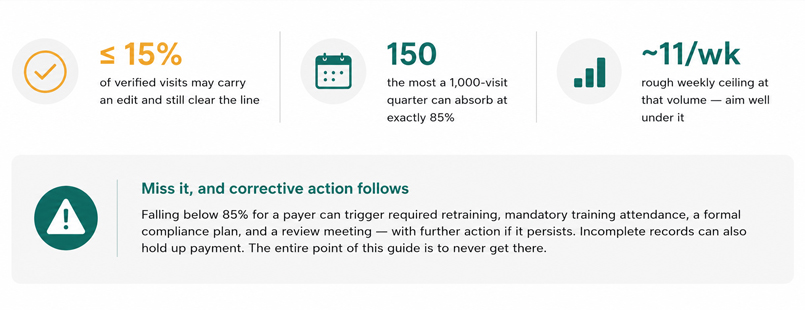
As of April 1, 2026, Michigan enforces Electronic Visit Verification under MDHHS Bulletin MMP 26-10. The headline requirement is short: every quarter, agency and FI/FMS providers must keep at least 85% of verified visits free of manual edits. And the math behind it is just as short.
HOW THE RATE IS CALCULATED verified visits with no manual edits ÷ total verified visits × 100 — per payer, per quarter |
That last phrase is the one that catches agencies off guard. The 85% threshold is scored per payer, not as a single agency-wide average. If you serve fee-for-service plus one or more managed care plans, you have to clear 85% with each of them on its own — there’s no blended number to hide behind. HHAeXchange issues a monthly Compliance Report to you and to every payer, so everyone is reading from the same data.
This is purely a measure of how cleanly each visit was captured at the source. It says nothing about the quality of care you deliver. Get the capture right at the door, and the rate largely takes care of itself.
The 7 manual edits that chip away at your rate
A manual edit is any correction made because a visit was captured incompletely or incorrectly. Each one counts against your 85%. Under MMP 26-10, all seven of these are the usual culprits:
- A missing clock-in time
- A missing clock-out time
- A missing clock-in and clock-out
- A missing caregiver on the visit
- A missing phone number when IVR is used
- Missing GPS when the mobile app is used
- Manually entering or changing a time the system already logged
Allowed, but never as a habit
MDHHS does accept manual edits. What it’s explicit about is that they must be kept to a minimum and should never be your primary way to capture a visit. The fix isn’t to chase zero edits; it’s to capture cleanly at the point of care so there’s nothing to correct in the first place. Keep edits rare enough that every payer stays above the line, and the rest follows.
The 5 mistakes that sink compliance
Almost every agency that drops below the line makes one of these first. Notice that none of them is about the software — they’re about how the rollout is run.
- Treating EVV as an IT project, not a behavior change. The platform is the easy part. Compliance is won or lost at the point of care, in whether every caregiver clocks in cleanly on every visit. Roll it out as a training-and-habit program, not a software install.
- Not monitoring the rate weekly. By the time the quarterly Compliance Report lands, the quarter is closed and the number is final. You can’t fix what you only see at the end. Watch the clean-capture rate as it builds.
- Ignoring the per-payer measurement. A healthy agency-wide average can still hide one managed care plan sitting below the line — and that single payer is enough to put you into corrective action.
- Assuming the data reached the aggregator. A perfectly captured visit that’s rejected at HHAeXchange still counts as zero. Captured is not the same as received. Reconcile your transmissions against your own records.
- Missing the live-in caregiver exemption paperwork. Live-in caregivers can be exempt — but only with a filed, approved, and current BPHASA-2421 attestation. Let it lapse and they drop straight back into your denominator.
Implementation in three steps
Whatever EVV system you run, getting compliant in Michigan comes down to three moves.
1. Get on HHAeXchange — whatever EVV you use
Complete the HHAeXchange Provider Onboarding Form (you’ll need an active NPI and CHAMPS enrollment). This is required even if you run your own EVV system through Michigan’s open vendor model.
2. Choose how you capture visits
Use the free HHAeXchange tools, or connect your own EVV platform via EDI. If you go third-party, complete the Third Party EVV Attestation and meet the technical and business requirements for clean data transmission.
3. Get caregivers live — and know the sync rule
Make mobile capture the default and train caregivers on clean clock-in and clock-out. One rule worth drilling: app visits captured offline must transmit to HHAeXchange within 7 calendar days, or they don’t count.
Three moves to push manual edits under 15%
Staying above 85% clean visits means keeping manual edits below 15%. These three moves do most of the work, because each one removes the reason an edit happens in the first place.
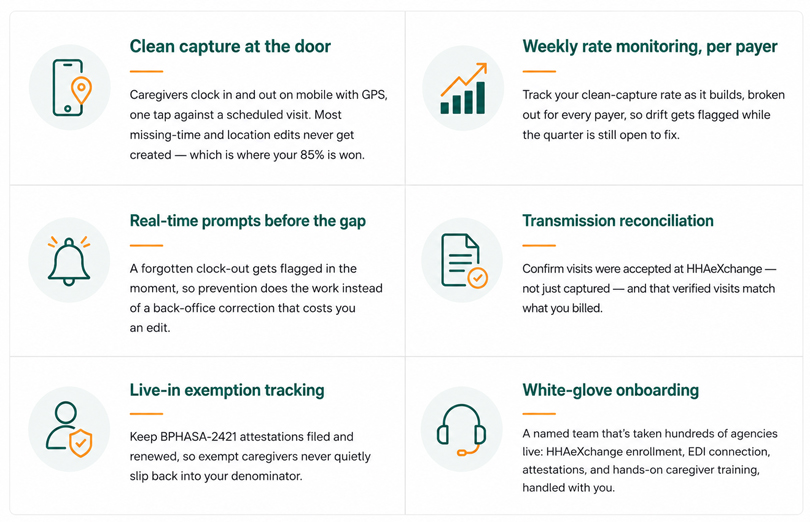
- Push the schedule to caregivers before every shift. When the visit is already on the phone, clocking in is one tap against a known appointment — not a blank form filled from memory. Most missing-time and wrong-time edits simply never get created.
- Verify check-in and check-out locations up front. Confirm the client’s address and GPS are correct in the system before visits begin. A clean location on file means a clean match at the door, instead of a mismatch that forces a manual location edit later.
- Build a daily logging habit for live-in caregivers — or file the exemption. Live-in caregivers generate the most edits when left to reconstruct visits later. Either log daily in the moment, or file the BPHASA-2421 exemption and keep it renewed.
Five habits that keep you above the line
- Capture at the door, not the desk. Mobile clock-in/out with reliable GPS as the default; reserve telephony and back-office fixes for genuine exceptions.
- Prompt before the gap happens. Flag a forgotten clock-out in real time. Prevention beats cleanup — and cleanup is what costs you the edit.
- Watch the rate weekly, per payer, so you can correct course before the quarter closes.
- Coach the few driving most edits. Manual edits cluster. A short, targeted coaching list fixes the bulk far faster than blanket retraining.
- Confirm the data actually reached HHAeXchange. Reconcile transmissions against your records — never assume they landed.
How Caretap EVV software keeps you above 85%?
Every habit in this guide comes down to the same thing: capturing each visit cleanly at the source and seeing your rate early enough to act. That’s precisely what Caretap’s Michigan EVV software is built to do — and because Michigan uses an open vendor model, Caretap connects straight to HHAeXchange via EDI, so you’re never locked into one tool to stay compliant.
And EVV on Caretap is always $0 — on the same open vendor model Michigan uses. It’s one piece of a connected platform that runs scheduling, billing, payroll, reporting, and compliance from a single source of truth, so verified visits flow straight into clean claims and payroll without double entry. Every day, 12,000+ caregivers capture visits on Caretap, and last year the platform billed $460M in claims for its agencies.
Your pre-review checklist
Run this in the final weeks before each quarterly review. Remember the schedule: the Apr–Jun quarter is reviewed in July, and Jul–Sep in October.
- Pull your clean-capture rate for every payer, not just the agency average.
- Confirm each payer is at or above 85% — with room to spare.
- Review the manual-edit log and identify the top 3 sources.
- Coach the caregivers and offices driving the most edits.
- Verify all app visits synced within 7 days and reached HHAeXchange.
- Confirm live-in caregiver attestations are current — not lapsed.
- Reconcile that verified visits match billed visits.

Best Home Care Software for Michigan Agencies in 2026: What to Look For | Caretap
August 5, 2026[…] them why before go-live, not the week of. Every agency that clears 85% comfortably communicated before launch, not during […]