
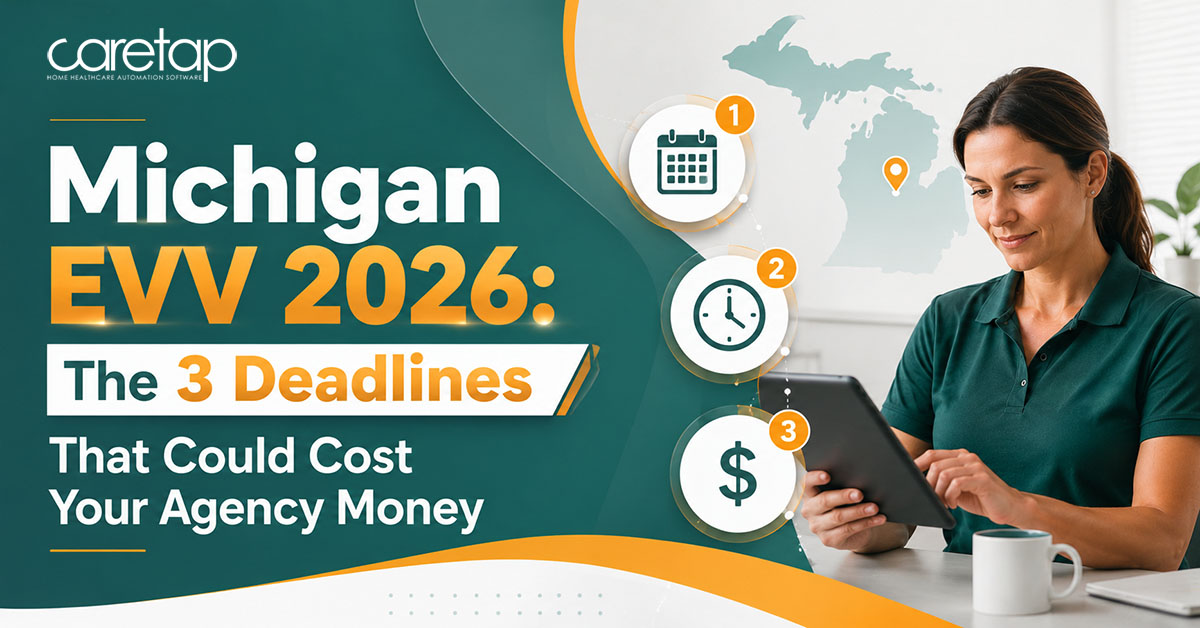

Here’s a number that should worry every Michigan home care agency: 85%. Starting April 1, 2026, that’s the minimum share of your Medicaid visits that must be free of manual edits checked separately for every single payer you bill, every single quarter. Miss it, and you’re not looking at a warning email. You’re looking at corrective action, retraining mandates, and a compliance plan with your name on it.
And that’s only the second deadline. The first one already happened, and it’s the one quietly choking cash flow at agencies that haven’t caught up.
If you’re running a Michigan agency billing Medicaid for personal care or home health services, Electronic Visit Verification isn’t a future project anymore. It’s the system standing between the care you deliver and the check you get paid. Here’s exactly what changed, what’s still changing, and what to do about it this week.
Why Michigan EVV Suddenly Has Real Consequences?
Michigan has required EVV since the federal 21st Century Cures Act took effect, but 2026 is the year enforcement stopped being theoretical. Two dates define it.
January 1, 2026, was the hard cutover for managed care home health claims. Before this date, agencies had some room to route around the state system. After it, managed care HHCS claims must run through Michigan’s EVV aggregator, no exceptions, no direct submissions to the health plan. Here’s the part that catches agencies off guard: an incomplete EVV record doesn’t generate a denial you can appeal. It generates no claim at all. The visit doesn’t exist for billing purposes until the record is complete.
April 1, 2026 is when MDHHS started enforcing the 85% clean-capture threshold under Bulletin MMP 26-10. This is the rule with real corrective-action teeth, and the first quarter under formal review, April through June, gets scored in July.
One of these deadlines quietly cuts off your cash flow. The other puts you on a state watch list. Both are already live.
What EVV Actually Has to Capture?
Federal law under the Cures Act sets the baseline. Michigan hasn’t changed it: every Medicaid personal care or home health visit delivered in the home needs six data points captured electronically: the type of service performed, who received it, the date, the location, who provided it, and the exact time the service began and ended. Capture happens through the HHAeXchange+ mobile app, IVR from the beneficiary’s landline, or a fixed device. Miss any one of those six elements on a given visit, and that visit is what feeds directly into your manual-edit rate under the 85% rule below.
Two requirements agencies routinely overlook: you need an active NPI and CHAMPS enrollment before a portal even gets created for you, and you must complete the HHAeXchange Provider Onboarding Form even if you plan to keep using your own software. No portal, no data transmission, no payment, regardless of how good your visit notes look on your end.
Who Actually Runs Michigan’s EVV System?
Michigan uses an open vendor model with a twist that trips up a lot of agencies: HHAeXchange is both the free state EVV system and the mandatory state aggregator. Every visit record, no matter what app, device, or software captured it, has to land in HHAeXchange before it can become a paid claim.
You can choose not to use HHAeXchange’s own capture app. You cannot choose to skip sending your data there. That distinction matters because it means “we already have EVV software” isn’t the same as “we’re compliant.” If your current vendor isn’t properly integrated with HHAeXchange, your visits aren’t reaching the aggregator and unreached visits don’t get paid.
Can You Keep Your Own EVV Software?
Yes. Michigan’s open vendor model lets you use a third-party system at your own cost, but only after it’s approved and integrated. That means completing the HHAeXchange Provider Onboarding Form, submitting a Third-Party EVV Attestation Form, and, if your vendor hasn’t already been tested in Michigan, passing file format validation before you can go live. Skip any step, and your visit data has nowhere to go.
This is where a lot of agencies lose weeks they didn’t budget for. Configuration doesn’t even start until the attestation form is submitted, and HHAeXchange expects near-real-time data, not batches of unchanged records dumped in once a week.
The 85% Rule, Broken Down
Under MMP 26-10, your clean-capture rate is calculated as verified visits with zero manual edits, divided by total verified visits per payer, per quarter. If you bill fee-for-service plus two managed care plans, you need 85% with each one independently. A strong blended average doesn’t protect you if one payer is quietly failing.
Seven things count as a manual edit against you: a missing clock-in, a missing clock-out, both missing together, a missing caregiver, a missing phone number for IVR visits, missing GPS for mobile-app visits, and any manual change to a logged clock-in or clock-out time. Notably, schedule changes don’t count against you; MDHHS confirmed that directly. Only edits to the actual visit clock times do.
Miss the threshold, and the corrective actions include mandatory retraining, required attendance at state or plan-sponsored training, a formal compliance plan, and progress meetings with the state or your managed care entity. New providers and agencies adopting a new EVV system get a grace period covering the current quarter plus the following full quarter to build clean habits before the score counts.
Not Every Visit Needs EVV
Exemptions exist, but they’re narrower than most agencies assume. Congregate residential settings, adult foster care, licensed respite, and homes providing 24/7 care to two or more unrelated people are exempt from EVV for personal care services. However, Home Help services in room-and-board settings still require it.
The bigger exemption is for approved live-in caregivers who share a permanent residence with the beneficiary. Getting approved means filing form BPHASA-2421 with two proofs of shared residency, and the caregiver must keep using EVV until that approval actually comes through. Renewal timing depends on the program: annually for managed care, every six months for Home Help. Mixing those up is one of the most common (and costly) mistakes agencies make.
Your Action List for This Quarter
If you only do five things this quarter, make it these:
- Confirm your NPI matches what your software transmits. A mismatch silently rejects every visit on a contract.
- Pull your clean-capture rate per payer, not your agency-wide average. Your worst payer is your real risk.
- Check the calendar before the quarter closes. Mid-quarter, you can still fix the number. Post-close, you’re writing an explanation.
- Audit every live-in caregiver attestation for its actual expiration. Annual for managed care, six months for Home Help.
- Turn off auto-rounding in your EVV or scheduling software. It silently rewrites clock times into manual edits at scale.
What This Means for Your Agency Right Now?
Every one of these rules ends the same way: a visit that isn’t captured cleanly, transmitted correctly, and verified on time is a visit that doesn’t get paid on schedule. That’s not a compliance abstraction; it’s payroll, it’s cash flow, it’s whether you can take on new referrals with confidence.
The agencies handling 2026 well aren’t necessarily the ones with the fanciest software. They’re the ones who can see their clean-capture rate per payer, mid-quarter, while there’s still time to fix it instead of finding out in a report a month after the quarter already closed.
That’s exactly the gap Caretap is built to close. Caretap processes EVV and billing specifically for Michigan home care agencies, with your HHAeXchange transmission status and per-payer compliance rate visible in real time, not buried in a monthly PDF.
See Your Compliance Picture Before It Costs You
You don’t have to guess whether your agency is one rejected NPI mismatch or one slipping payer away from a corrective action letter. Book a 15-minute walkthrough with a Michigan EVV specialist and get a direct look at your portal setup, your transmission status, and your live per-payer compliance number.
Eligible Michigan agencies get EVV at $0, plus the first three months of the full Caretap platform at no additional cost.