

Electronic Visit Verification (EVV) is no longer optional for Illinois home care agencies. As we move into 2026, compliance expectations are tighter, audits are more structured, and Medicaid claim reviews are increasingly automated.
Illinois agencies providing Medicaid-funded personal care and home health services must follow strict EVV documentation standards. Even small documentation errors can delay reimbursement or trigger corrective action plans.
This guide is for:
- Home care agency owners
- Administrators and compliance officers
- Billing managers
- Operations teams managing caregiver workflows
Our goal is simple: provide a clear, practical explanation of Illinois EVV requirements for 2026 and show how agencies can stay compliant without increasing administrative burden.
If your agency struggles with visit corrections, claim delays, or EVV audit stress, this blog will clarify what Illinois requires and how to simplify compliance.
What Is EVV and Why Does Illinois Require It?
Electronic Visit Verification (EVV) is a system that electronically confirms that a caregiver visit actually occurred.
EVV became mandatory under the federal 21st Century Cures Act, which requires states to implement EVV for Medicaid-funded personal care and home health services.
Illinois adopted EVV to:
- Reduce Medicaid fraud
- Improve accountability
- Ensure services billed were actually delivered
- Increase transparency in home-based care
In simple terms, EVV records key details of a visit:
- Who received the service
- Who provided it
- When it started and ended
- Where it took place
- What service was delivered
Without this verification, Medicaid claims can be denied.
EVV is not just a documentation tool. It is directly tied to payment and compliance.
Illinois EVV Requirements in 2026
The EVV program in Illinois is overseen by the Illinois Department of Healthcare and Family Services (HFS).
As of 2026, the following providers must comply:
- Agencies delivering Medicaid-funded personal care services
- Agencies providing Medicaid-funded home health services
The Six Required EVV Data Elements
Illinois requires agencies to capture six federally mandated data elements for every applicable visit:
- Type of service performed
- Individual receiving the service
- Date of service
- Location of service delivery
- Individual providing the service (caregiver)
- Start time and end time of the visit
If any of these elements are missing or inaccurate, the visit may fail validation before claims are processed.
Submission Requirements
EVV data must be:
- Electronically captured
- Submitted to the state’s EVV aggregator
- Matched accurately to the corresponding Medicaid claim
In 2026, Illinois continues enforcing compliance thresholds. Agencies that fall below required verification percentages may face warnings, claim denials, or corrective action plans.
How Illinois Collects EVV Data
Illinois uses an aggregator model for EVV data collection.
The state’s designated aggregator is HHAeXchange.
Agencies have two options:
Option 1: Use the State-Provided System
Agencies can directly use the EVV system supported by the state’s aggregator.
Option 2: Use a Third-Party EVV Software
Agencies may use an independent EVV software solution, provided it integrates with HHAeXchange and meets Illinois data formatting and submission requirements.
For agencies that prefer flexibility, using independent Illinois EVV software that integrates with the state system allows better workflow control without sacrificing compliance.
A lot of agencies go this way because it has a lot of benefits:
- Keeps all of your scheduling, timesheets, and billing in one place.
- Cuts down on entering the same data twice
- Reduces mistakes in reconciliation
Common EVV Compliance Challenges in Illinois
In theory, EVV is simple, but putting it into practice can cause problems in the real world.
Here are some problems that Illinois agencies often have to deal with:
Visit Corrections
Caregivers may forget to clock in or out. Missing timestamps require manual correction and documentation before submission.
Caregiver Clock-In Errors
Incorrect service codes, incorrect client selection, or time overlaps can cause a visit to be rejected.
Manual Reconciliation Before Billing
Agencies often must manually verify that EVV data aligns with scheduled services before claims submission.
How Caretap Helps Illinois Agencies Stay Compliant
Caretap is an Illinois EVV software designed to help agencies meet state EVV requirements while reducing administrative cleanup.
Rather than adding another disconnected system, Caretap Illinois EVV Software focuses on aligning EVV workflows with scheduling, payroll, and billing.
Here’s how it supports compliance:
Captures All Required EVV Data Elements
- Automatically logs service type
- Records caregiver and client details
- Captures date, location, and visit duration
This ensures every visit includes the six federally required data points.
Reduces Visit Corrections
- Guided caregiver clock-in prompts
- Real-time alerts for missing data
- Supervisor visibility into incomplete visits
By catching issues early, agencies avoid large correction backlogs.
Faster Billing Readiness
- EVV visits integrate with billing workflows
- Reduced need for manual reconciliation
- Fewer rejected claims
When visit verification is clean, claims processing becomes smoother.
Learn more about our Illinois EVV software to see how integration supports compliance without additional administrative strain.
2026 Compliance Risks Agencies Should Monitor
EVV enforcement continues to evolve. Agencies should be aware of increasing oversight in 2026.
Increased Audit Scrutiny
State reviews may analyze:
- EVV validation percentages
- Visit correction frequency
Medicaid Claim Denials
If EVV data does not match claim submissions, reimbursement can be delayed or denied.
Corrective Action Plans
If someone keeps not following the rules, they may have to make formal improvement plans, report more often, or be watched more closely.
It’s better to be proactive than to react to punishments.
Best Practices to Stay EVV Compliant in Illinois
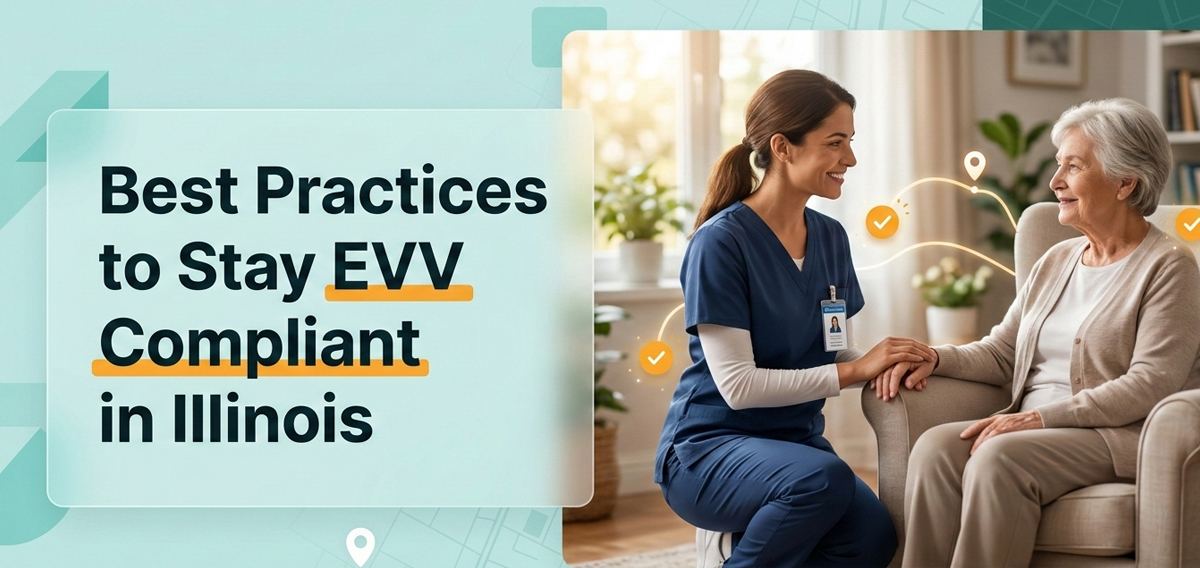
Compliance does not have to be complicated. Agencies that implement consistent internal processes experience fewer disruptions.
Here are practical best practices:
Train Caregivers Properly
Ensure caregivers understand:
- How to clock in and out
- How to select the correct service codes
- What to do if technical issues occur
Clear onboarding reduces downstream corrections.
Monitor Compliance Weekly
Use dashboards to:
- Track incomplete visits
- Identify frequent error patterns
- Review exception reports
Early correction prevents billing bottlenecks.
Review Rejected Visits Daily
Do not wait until payroll or billing cycles to fix errors. Daily reconciliation keeps compliance levels stable.
FAQs About Illinois EVV
Is EVV mandatory in Illinois?
Yes. EVV is required for Medicaid-funded personal care and home health services under federal and state regulations.
Can agencies use their own EVV software?
Yes, agencies can use third-party EVV systems as long as they work with HHAeXchange and meet Illinois data requirements.
What happens if EVV data is missing?
Claims associated with incomplete EVV records may be denied or delayed. Agencies may also fall below compliance thresholds.
Does Illinois require GPS tracking?
Illinois requires location verification. Many agencies use GPS-enabled mobile applications, but telephony verification from the client’s home is also permitted, provided it complies with state standards.
Conclusion
EVV compliance in Illinois is not optional. It is directly tied to Medicaid reimbursement and agency accountability.
Expectations for enforcement are still high in 2026. Visit corrections, reconciliation delays and failures to upload to the aggregator can all make things take much longer.
The right system prevents problems before billing.
Agencies that use a purpose-built Illinois EVV software reduce corrections, speed billing, and stay compliant without adding administrative burden.
If your agency wants to simplify Illinois EVV compliance while protecting revenue, now is the time to review your system and strengthen your workflows.
Book a demo or learn more to see how compliance can become part of your routine, not a recurring stress point.