



The Non-Emergency Medical Transportation (NEMT) industry has entered a new era.
Demand is rising due to ageing populations, expanded Medicaid programs, value-based care models, and increased focus on social determinants of health. At the same time, Medicaid brokers and state agencies are tightening documentation requirements, increasing audit frequency, and demanding greater transparency in trip validation.
Meanwhile, providers are facing workforce shortages, tighter margins, and increasing billing complexity.
In 2026, choosing NEMT software is no longer an IT decision; it’s a financial and compliance decision.
Modern NEMT platforms now control:
- Revenue cycle performance
- Medicaid claim accuracy
- Compliance audit readiness
- Fleet efficiency
- Driver accountability
- Real-time trip documentation
This NEMT software buyer guide 2026 is designed to help providers make a confident, future-proof decision.
The State of NEMT Technology in 2026
From Dispatch Tools to Full Operating Platforms
NEMT technology has come a long way since it was just used for dispatching. Now it is full operating platforms. In 2015, most providers used basic scheduling systems, manual dispatch boards, spreadsheets, and limited reporting. By 2020, platforms had changed to include driver mobile apps, dispatch, GPS tracking, and route optimization. But billing and compliance systems were still often kept apart. The change in 2026 will be to real end-to-end workflow automation.
The best NEMT software today has all of these features in one easy-to-use system: scheduling and dispatch, trip documentation, Medicaid billing, compliance tracking, fleet management, and real-time analytics. By switching from separate tools to an all-in-one operating platform, NEMT providers are changing the way they do business, getting fewer denials, staying compliant, and growing in a smart way.
Why Providers Are Replacing Legacy Systems?
Providers are upgrading their systems because:
- Medicaid billing is becoming more complicated.
- Strict rules for keeping audit records
- API integrations required by brokers
- Expectations for real-time trip proof
- High rates of claim denial
Legacy systems that use manual billing processes or modules that aren’t connected are losing money and making it harder to follow the rules.

Key Industry Forces Shaping NEMT Software
- Efforts to modernize Medicaid
- Requirements for data transparency and trip verification
- Worker shortages are driving the need for automation.
- Requirements for broker integration
- Expectations for real-time GPS validation and timestamp proof
To put it simply, the market now wants more than just dispatch; it wants automation.
Who This Buyer’s Guide Is For
- New NEMT Startups: This is for startups that want to build operations that can scale from day one without doing things by hand.
- Growing Fleets (10-100 Vehicles): This is ideal for fleets that are struggling with scheduling, billing, or compliance.
- Enterprise / Broker-Contracted Providers: Designed for providers who need robust integrations, advanced reporting, and automated compliance management.
- Multi-State Providers: Great for businesses that have to deal with different state rules and many payers across different areas.
Core Components of Modern NEMT Software (2026 Standard Stack)
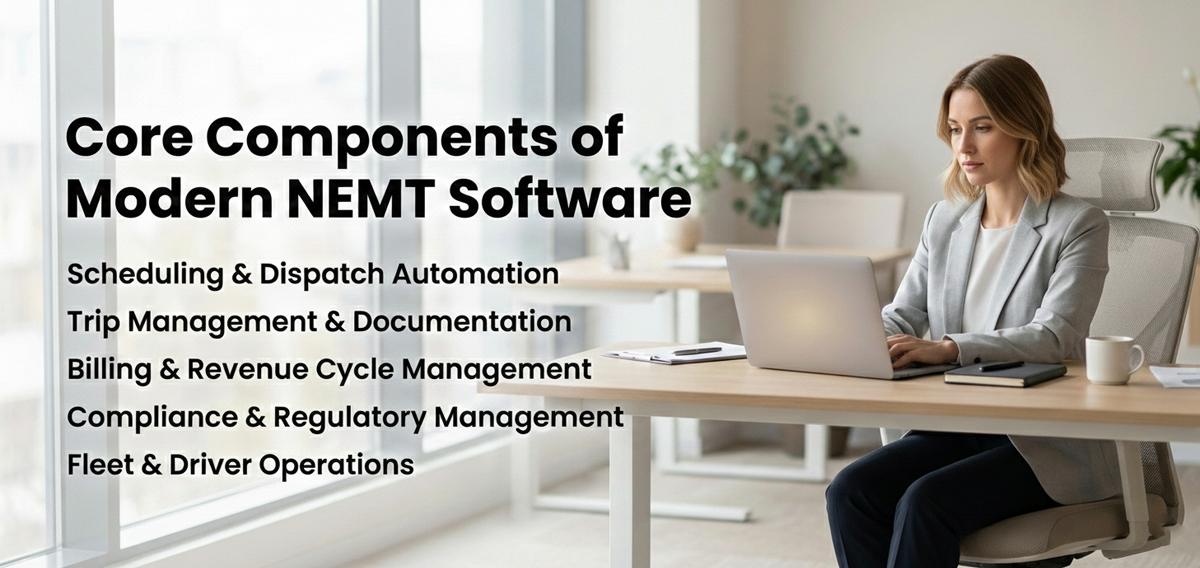
1. Scheduling & Dispatch Automation
Important things to know when buying modern NEMT dispatch software are:
- Scheduling in real time
- Logic for matching drivers
- Optimizing routes
- Finding trip conflicts
- Managing trips on the same day
- Reassignments that happen automatically
In 2026, manual scheduling will no longer be feasible at scale.
2. Trip Management & Documentation
Medicaid documentation requirements are stricter than ever.
Look for:
- Electronic trip records
- Timestamp + location validation
- GPS-backed proof of service
- Trip lifecycle tracking (scheduled → assigned → en route → completed)
- Electronic signatures
Without automated trip documentation, billing risk increases.
3. Billing & Revenue Cycle Management
A full guide to Medicaid billing NEMT software should have:
- Automating Medicaid billing
- Billing for commercial insurance
- Integrations with clearinghouses
- Submitting claims in batches
- Posting ERA/remittance
- Workflows for managing denials
- Tracking the status of claims in real time
Billing is where you make or lose money.
Stop Losing Revenue to Billing Errors. Get paid faster with a unified NEMT billing platform
4. Compliance & Regulatory Management
HIPAA-compliant NEMT software vendors must provide:
- Encrypted data storage
- Role-based access controls
- Audit logs
- Automated compliance alerts
- State documentation tracking
- Medicaid rule validation
Compliance automation reduces audit stress and financial exposure.
5. Fleet & Driver Operations
Operational efficiency depends on:
- Driver credential tracking
- License monitoring
- Vehicle maintenance scheduling
- Insurance expiration alerts
- Safety reporting dashboards
Manual spreadsheets for compliance tracking are high-risk in 2026.
6. Mobile Workforce Enablement
Modern platforms must include:
- Driver mobile apps
- Rider communication tools
- Digital signatures
- Trip workflow automation
- Real-time dispatch updates
Mobile usability directly impacts driver adoption and operational success.
Advanced Capabilities Top Providers Are Prioritizing in 2026
Forward-thinking providers are looking for:
- AI scheduling & predictive routing
- Automated compliance monitoring
- Broker & payer API integrations
- Real-time performance analytics
- Financial forecasting dashboards
Software is no longer reactive; it is becoming predictive.
NEMT Software Pricing Models Explained (2026 Reality)
Understanding NEMT software cost and pricing models is critical.
Common Pricing Models
- Per-trip pricing
- Per vehicle pricing
- Per user pricing
- Flat platform subscription
Each model impacts scalability differently.
Hidden Costs Buyers Miss
Many buyers overlook:
- Implementation fees
- Staff training costs
- Integration fees
- Customization charges
- Support tier upgrades
- Data migration services
A low sticker price does not equal low total cost.
Total Cost of Ownership (TCO) Framework
When looking at NEMT software vendors, think about:
- Cost of a software subscription
- Savings on operational labor
- Better billing efficiency
- Less rejection of claims
- Reducing the risk of noncompliance
- Opportunities to move staff around
The right platform often pays for itself by reducing denials and speeding up the revenue cycle.
How to Evaluate NEMT Software Vendors: Step-by-Step Framework?
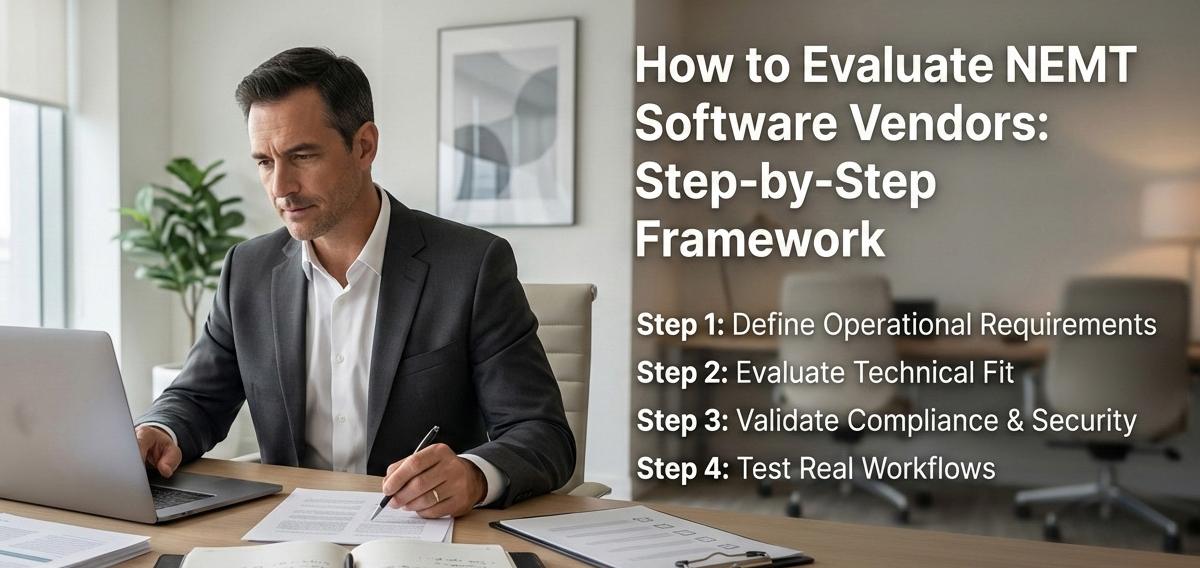
Step 1: Define Operational Requirements
Clarify:
- Fleet size
- Monthly trip volume
- Service types (ambulatory, wheelchair, stretcher)
- Payer mix (Medicaid, MCO, private)
Step 2: Evaluate Technical Fit
Assess:
- Level of automation
- Integration ecosystem
- Reporting depth
- API capabilities
- Scalability
Step 3: Validate Compliance & Security
Confirm:
- HIPAA compliance
- Data encryption standards
- Audit logs
- Role-based permissions
- Disaster recovery plan
Step 4: Test Real Workflows
Request:
- Dispatch simulations
- Billing test claims
- Driver mobile app demo
- Trip documentation walkthrough
- Reporting sample outputs
If the vendor cannot demonstrate real workflows, reconsider.
Questions Every Buyer Should Ask Vendors
Product Questions
- Is this a complete NEMT platform or just a bunch of add-ons that work together?
- How often does the platform get new features?
Compliance Questions
- How do you handle Medicaid audit documentation?
- What encryption standards are used?
Billing Questions
- Is batch claim submission supported?
- How are denials tracked and resolved?
Implementation Questions
- What is the onboarding timeline?
- Is data migration included?
Support Questions
- What are support hours?
- Is dedicated account management provided?
Red Flags to Watch For When Buying NEMT Software
- Poor onboarding support
- Manual billing workflows
- Limited integrations
- No compliance automation
- Outdated user interface
- Slow system performance
- No real-time GPS validation
Implementation Best Practices After Purchase
Data Migration Strategy
Audit existing data before transfer.
Staff Training Plan
Provide role-based training for dispatch, billing, and drivers.
Pilot Rollout Strategy
Launch with a small fleet segment first.
KPI Tracking - First 90 Days
Track:
- Claim acceptance rates
- On-time trip percentage
- Denial rates
- Dispatch efficiency
- Driver app adoption
Implementation success determines ROI.
Future of NEMT Software
The next step is:
- AI dispatch helpers
- Alerts for predictive compliance
- Ready for autonomous fleet integration
- Ecosystems for patient engagement
- Scoring broker performance in real time
Technology will keep moving from helping with operations to giving them intelligence.
NEMT Software Buyer Checklist
Before signing any contract, confirm:
- Operational fit
- Automation depth
- Billing capabilities
- Compliance tools
- Mobile experience
- Integration support
- Reporting & analytics depth
- Vendor support quality
- Transparent pricing
- Scalability roadmap
This NEMT software selection checklist ensures a structured evaluation.
Final Thoughts: Choosing a Long-Term Technology Partner
The best NEMT software for providers not only offers many features but is also scalable, compliant, and focused on making money.
When you look at vendors, keep these things in mind:
- Understanding the business
- Strong automation for following the rules
- Billing that makes sense
- Architecture that can change and grow
- Support that works
- Roadmap for new ideas
Providers are increasingly choosing platforms that combine scheduling, billing, compliance, and reporting into a single system. This lowers risk and makes revenue more predictable.
In 2026, choosing the right NEMT software is about more than just speeding up dispatches. It’s also about building a business that can last, pass audits, and make the most money.
Learn More
FAQ Section
How much does NEMT software cost in 2026?
Prices differ depending on the model (per trip, per vehicle, per user, or subscription). You should expect to pay more for training, implementation, and integrations.
How long does it take to put it into action?
Depending on the size of the fleet and the need for customization, most modern platforms can be set up in 2 to 8 weeks.
Do you need NEMT software to send bills to Medicaid?
Automated Medicaid billing systems make it much less likely that claims will be denied or that audits will happen, even though they aren’t always required by law.

tetracycline hcl 500 mg capsule
March 31, 2026tetracycline hcl 500 mg capsule
tetracycline hcl 500 mg capsule
augmentin for uti
April 4, 2026augmentin for uti
augmentin for uti
lasix medicine price
April 13, 2026lasix medicine price
lasix medicine price
vidalista 10 mg tablets
April 24, 2026vidalista 10 mg tablets
vidalista 10 mg tablets
dapoxetine et cialis
May 4, 2026dapoxetine et cialis
dapoxetine et cialis
how to pronounce topiramate
May 16, 2026how to pronounce topiramate
how to pronounce topiramate
xenical precio farmacia
May 16, 2026xenical precio farmacia
xenical precio farmacia
Onset Timing Under Alcohol
September 21, 2026Onset Timing Under Alcohol
Onset Timing Under Alcohol