

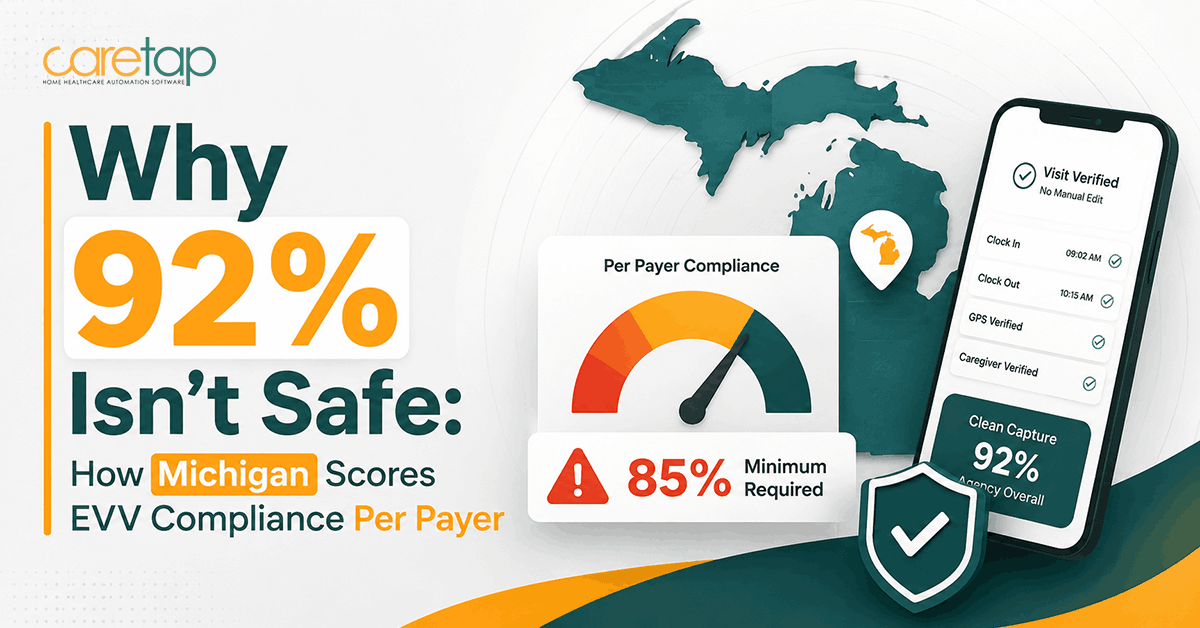

Picture the moment your quarterly compliance report lands. Your agency-wide clean-capture rate reads 92%. You exhale. You’re above the line, the caregivers are clocking in, the claims are going out. Then you scroll to the payer breakdown — and one managed-care plan is sitting at 78%.
That single number just put your agency into corrective action. Not the 92%. The 78%.
If that scenario made your stomach drop, you already understand the most misunderstood part of Michigan’s EVV rule. Most agency owners think of the 85% threshold as one score to clear. It isn’t. It’s a score you have to clear on every payer you bill, separately, every quarter. And the agencies that get blindsided almost never fail because they’re bad at care or bad with software. They fail because they were watching the wrong number.
Here’s exactly how per-payer scoring works, why a healthy average can hide a failing plan, and what actually keeps every payer above the line.
The 85% rule, in plain English
Since April 1, 2026, Michigan has enforced Electronic Visit Verification under MDHHS Bulletin MMP 26-10. The core requirement is short: each quarter, at least 85% of your verified visits must be captured with no manual edits. Put the other way, no more than 15% of your visits can require a correction after the fact.
This applies to agency and FI/FMS providers delivering Medicaid personal care services (PCS) and home health care services (HHCS) — the services the federal 21st Century Cures Act requires states to verify electronically.
That much, most administrators know. It’s the next sentence that catches people off guard.
The part nobody reads twice: "per payer"
The 85% threshold is measured separately for each payer, not as one blended agency-wide average.
Michigan’s own managed-care plans state this plainly. Meridian’s provider guidance notes that the standard applies separately to each payer when you work with more than one program or health plan. Independent EVV vendors describe the same thing: the rule applies to fee-for-service and each managed care entity individually.
So if you bill Medicaid fee-for-service plus two managed-care plans, you don’t have one 85% target. You have three. And you have to clear all three, independently, every quarter.
That changes everything about how you should read your numbers. A strong overall rate is not proof that you’re safe — it’s an average, and averages hide their worst member. The plan that’s dragging can be completely invisible until the quarter closes and the per-payer report exposes it.
The math that makes one payer dangerous
Here’s why a small, low-volume payer is the one most likely to sink you.
Say your quarter looks like this:
Payer | Visits | Clean-capture rate | Status |
Medicaid FFS | 1,400 | 94% | Pass |
Managed Care Plan A | 900 | 91% | Pass |
Managed Care Plan B | 180 | 79% | Fail |
Agency-wide average | 2,480 | ~92% | Looks fine |
Your blended rate is a comfortable 92%. But Plan B — the smallest book of business, the one nobody’s watching — is at 79%. Under per-payer scoring, that plan alone triggers corrective action, no matter how spotless the other two look.
And low-volume payers are exactly where this happens, because the math is unforgiving at small numbers. On a 180-visit quarter, you only need about 38 manual edits to fall under 85%. A single caregiver who’s shaky on the app, assigned mostly to that one plan, can blow the whole payer in a few weeks — while your big FFS book absorbs its own mistakes and keeps your average looking healthy.
The uncomfortable takeaway: your average is the number that makes you feel safe, and your worst payer is the number that actually decides your fate.
What counts as a "manual edit"?
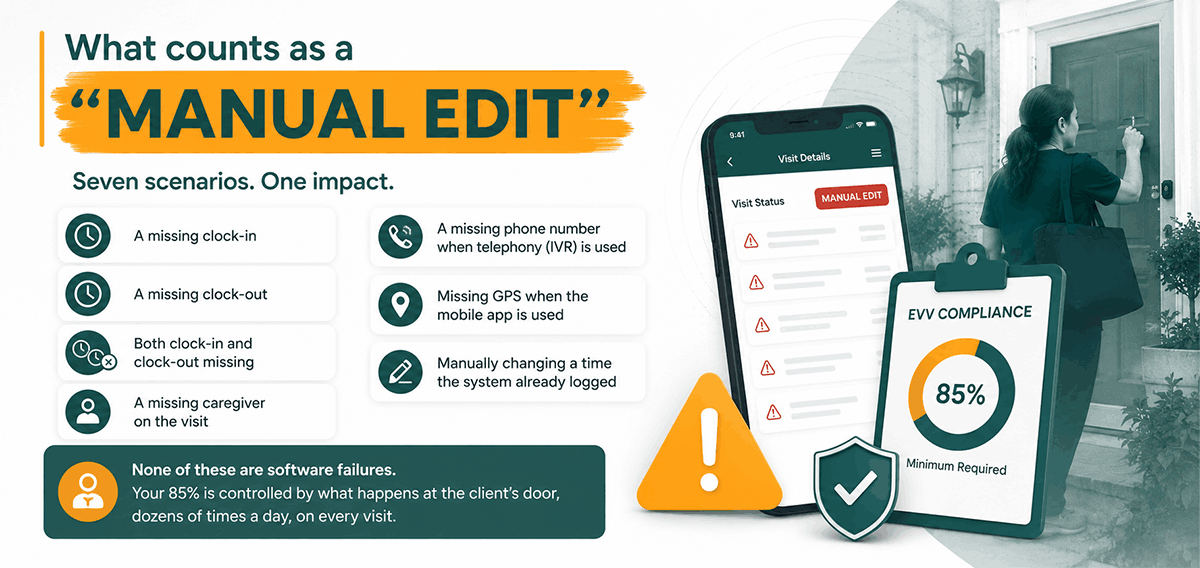
If manual edits are what pull you under, it’s worth being precise about what one is. Per MMP 26-10, a manual edit is any correction you make because a visit wasn’t captured cleanly the first time. MDHHS accepts manual edits — it just says they should never be your primary way of capturing a visit, and they must be kept to a minimum.
Seven scenarios are the usual culprits:
- A missing clock-in
- A missing clock-out
- Both clock-in and clock-out missing
- A missing caregiver on the visit
- A missing phone number when telephony (IVR) is used
- Missing GPS when the mobile app is used
- Manually changing a time the system already logged
Notice what these have in common: none of them is a software failure. The app didn’t forget to clock out — a person did. Which means your 85% isn’t controlled by a setting you configure once. It’s controlled by what happens at the client’s door, dozens of times a day, on every visit.
What happens if you miss it on one payer?
Falling below 85% on even a single payer isn’t a warning-letter situation. Based on MDHHS’s enforcement framework and payer guidance, the consequences include a formal corrective action plan, mandatory retraining, additional oversight and compliance review, and — the one that hits hardest — delayed or held reimbursement while you sort it out.
There’s a second, quieter revenue risk too. A visit that’s missing or incomplete can’t always become a clean claim, and Michigan has been explicit that failing to meet EVV requirements can affect payment for the affected services. So the same broken visit costs you twice: once against your compliance rate, and once against the claim it should have become.
The real trap: you find out too late
Here’s the timing problem that turns a manageable rule into a crisis.
Michigan’s compliance is scored on the quarter and reviewed after it closes — the review cadence lands in January, April, July, and October, using the monthly reports that accumulate in HHAeXchange. Which means if you only look when the official report arrives, you’re looking at a number you can no longer change. The quarter is locked. The corrective action is already coming.
This is the difference between the agencies that clear 85% comfortably and the ones that scramble. It usually isn’t better software or better caregivers. It’s timing. The agencies that stay safe catch a drifting payer in week six — while there’s still runway in the quarter to retrain a caregiver and fix the pattern — instead of discovering it in the post-quarter report when nothing can be done.
How to protect every payer, not just your average?
Check your rate every week, by program
Not just your overall number; that hides too much. Look at each program or payer separately on a weekly basis so you can catch one slipping before it costs you.
Make the clean version the easy version
Train caregivers on what a complete visit looks like: app open before care starts, GPS on, signature done, clock-out tapped before they leave. Every edit starts because something wasn’t quite finished. Make finishing it the default, not an extra step.
Make sure the visit actually got there
A visit can look perfect on someone’s phone and still not count if it never made it to HHAeXchange. Check your accepted, rejected, and pending visits regularly so a silent rejection doesn’t quietly eat into your rate.
Where a better setup actually helps?
You can’t buy your way out of this one. It comes down to what happens at the door, visit by visit. But the right system makes that job easier: it can show you a program starting to slip while you still have time to fix it, confirm visits actually reached HHAeXchange instead of leaving that to a spreadsheet, and make clean capture the path of least resistance for your caregivers.
That’s what Caretap’s Michigan EVV tools are set up to do. Show you your clean-capture rate by program in real time, confirm transmissions automatically, and take the guesswork out of “did that visit actually count.”
Conclusion
The 85% rule isn’t difficult because caregivers occasionally make mistakes. It becomes difficult when small manual edits happen so often that they quietly become part of your daily workflow. By the time those edits show up in a quarterly compliance report, there’s nothing left to fix.
The agencies that stay above the threshold don’t wait for quarterly reviews. They monitor their clean-capture rate throughout the quarter, address patterns early, and give caregivers the tools and training to capture visits correctly the first time. That’s the difference between reacting to compliance issues and staying ahead of them.

Best Home Care Software for Michigan Agencies in 2026: What to Look For | Caretap
August 5, 2026[…] There’s no averaging your way out. Bill Medicaid fee-for-service plus two managed care plans, and you need 85% on all three independently. A comfortable 91% agency-wide number can be hiding one plan at 78%. We broke that math down in why 92% still isn’t safe. […]
Best Home Care Software for Michigan Agencies in 2026: Buyer's Guide
August 5, 2026[…] There’s no averaging your way out. Bill Medicaid fee-for-service plus two managed care plans, and you need 85% on all three independently. A comfortable 91% agency-wide number can be hiding one plan at 78%. We broke that math down in why 92% still isn’t safe. […]