



It’s 7:30 PM. Your RBTs just wrapped up their last sessions of the day. And instead of heading home, they’re sitting at their desks catching up on session notes they couldn’t complete in real time. Meanwhile, your billing coordinator is cross-referencing a spreadsheet to check whether Mrs. Thompson’s authorization hours have been exceeded — a process that takes 20 minutes and still isn’t foolproof.
Your practice management software is technically working. Nobody is complaining about crashes or major outages. But between the delayed documentation, the manual authorization tracking, and the billing gaps no one has time to investigate, your practice is losing thousands of dollars every single month.
And you may not even know it.
The uncomfortable truth is this: outdated ABA practice management software doesn’t need to fail to cost you money. It just needs to be slow, disconnected, and manual — and most legacy tools are all three.
What "Functional" ABA Software Is Really Costing Your Practice?
There’s a common trap in ABA practice management: if the software works, why fix it?
The answer is that “working” and “performing” are two very different things. A system can process data, generate reports, and manage schedules while still creating enormous inefficiencies behind the scenes — inefficiencies your team absorbs every single day in the form of extra work, workarounds, and manual processes.
Here’s what that actually looks like in dollar terms:
When RBTs spend 30 to 45 minutes after each session completing documentation, you’re paying clinical staff to do administrative work. When billing and scheduling aren’t integrated, completed sessions don’t automatically flow into claims — creating delays, errors, and denials that eat into your reimbursements. When authorization limits aren’t monitored automatically, it only takes a handful of sessions over the approved limit to trigger a costly audit or an unpaid claim batch.
None of these failures are dramatic. They don’t trigger error messages or system alerts. They just quietly drain your revenue, one session at a time.
5 Signs Your ABA Software Is Quietly Draining Revenue
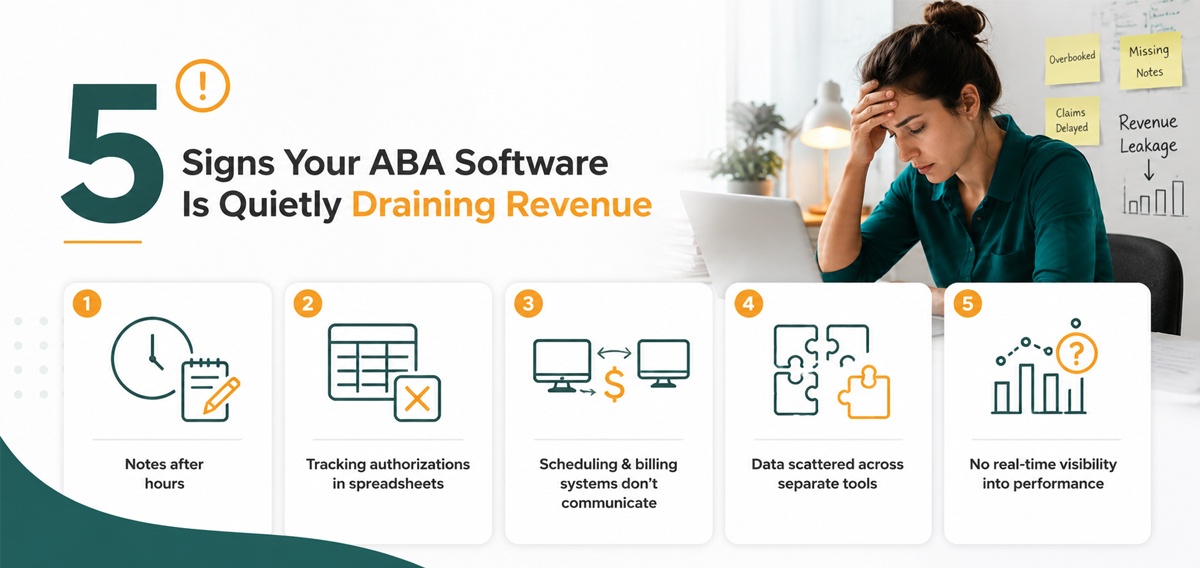
If any of these situations sound familiar, your current ABA practice management software is likely costing you more than you realize.
- Your RBTs are completing session notes after hours. Real-time documentation is the standard in modern ABA practice. If your team is writing notes after sessions end, you’re losing accuracy, risking compliance issues, and burning out your clinical staff.
- You’re tracking authorizations in spreadsheets. Authorization management is one of the highest-risk areas in ABA billing. If your team is manually checking authorization limits rather than having the software flag them automatically, you’re one oversight away from a denied claim batch.
- Your scheduling and billing systems don’t communicate. If a completed session doesn’t automatically generate a billing record, someone has to make that connection manually — and manual processes mean errors, delays, and missed revenue.
- Program targets and measurement data live in separate tools. BCBAs need a single, unified view of client progress. When clinical data is siloed from scheduling and billing, supervision decisions are slower, documentation is inconsistent, and compliance gaps are harder to catch.
- You have no real-time visibility into practice performance. If you’re waiting until the end of the month to understand your revenue health, utilization rates, or claim denial patterns, you’re managing your practice from the rearview mirror. By the time you see a problem, it’s already cost you.
The Real Cost of Staying With Legacy ABA Software in 2026
The financial impact of outdated ABA software extends well beyond obvious billing errors.
Underbilled sessions and uncaptured units are perhaps the most direct cost — when session data isn’t captured in real time and linked directly to billing, units frequently get underreported or missed entirely. Over a month of sessions across a mid-sized practice, that gap adds up fast.
Compliance risk is equally significant. When session documentation and billing records don’t match, your practice is exposed during audits. BCBAs and RBTs face documentation requirements that outdated tools simply weren’t built to support efficiently, creating a compliance burden that grows heavier every year.
Then there’s staff turnover. Administrative overload is one of the leading drivers of BCBA and RBT burnout. When your clinical team spends hours on paperwork that modern software would handle automatically, you’re not just paying for inefficiency — you’re accelerating turnover in a field where staffing is already one of the biggest operational challenges.
Finally, outdated software makes it nearly impossible to scale. If every new client adds proportional administrative burden, your growth ceiling is lower than it should be. The practices that are scaling efficiently in 2026 are the ones that invested in integrated, automated operations.
How Caretap ABA Software Fixes Every One of These Problems?
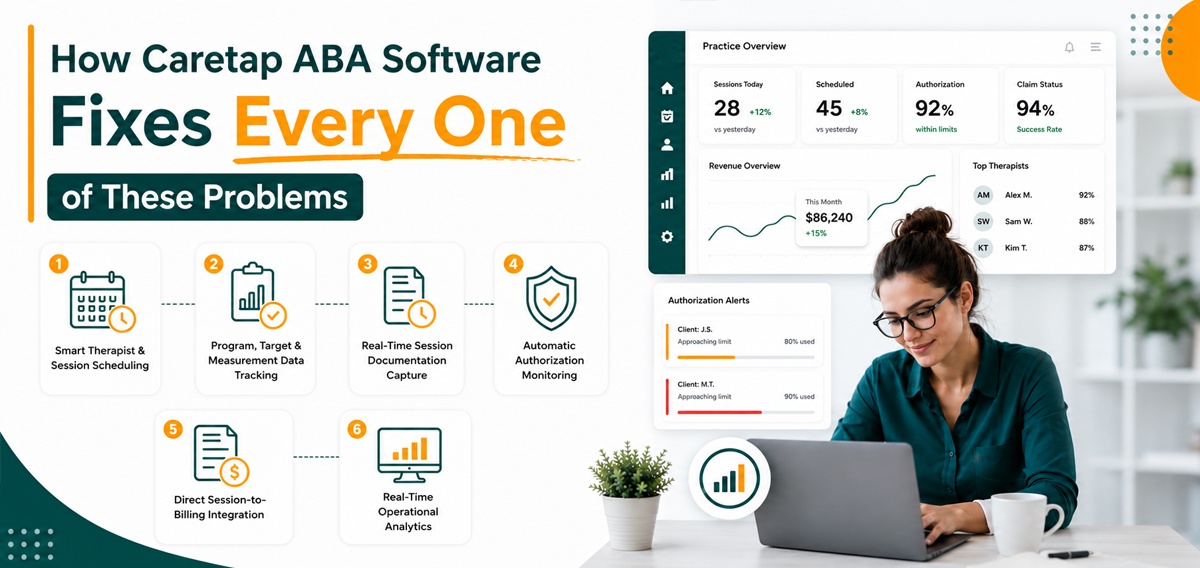
Caretap ABA Software was built specifically for the operational realities that ABA providers, BCBAs, and RBTs face every day. It’s not a generic healthcare platform retrofitted for ABA therapy — it’s a purpose-built ABA practice management system designed to eliminate the exact inefficiencies described above.
Here’s how it works in practice:
Smart therapist and session scheduling takes the guesswork out of capacity management. Caretap matches therapist availability, client authorizations, and session requirements in one place — reducing scheduling gaps, no-shows, and double-bookings.
Program, target, and measurement data tracking gives BCBAs a unified clinical workspace. Track behavior programs, monitor target mastery, and record measurement data in the same system where you manage scheduling and billing — no more toggling between tools or reconciling data across platforms.
Real-time session documentation capture means clinical data is recorded at the point of care. Every session detail is time-stamped, clinically accurate, and immediately available for billing and supervision review.
Automatic authorization monitoring is one of Caretap’s most practice-protecting features. The system tracks authorization limits in real time and alerts your team before sessions exceed approved hours — eliminating one of the most common and costly billing compliance errors in ABA.
Direct session-to-billing integration closes the loop between care delivery and claim submission. When a session is completed in Caretap, it connects automatically to billing — with the correct codes, units, and dates pre-populated. No manual entry. No missed sessions. No delayed claims.
Real-time operational analytics give practice leaders a live dashboard of what’s happening across their entire operation — session volume, billing status, authorization utilization, therapist productivity, and revenue health — all in one place, updated in real time.
What ABA Practices Gain When They Modernize Their Software Stack?
upgrade — it changes what your practice is capable of.
Faster, cleaner claim cycles mean your revenue arrives sooner and with fewer denials to chase. RBTs spend more time doing the clinical work they were trained for and less time doing administrative tasks that software should handle. BCBAs gain the supervision bandwidth to manage more clients without sacrificing oversight quality. And practice leaders finally have the real-time visibility they need to make informed, proactive decisions — not reactive ones.
Perhaps most importantly, your practice becomes scalable. When operations are integrated and automated, adding clients, therapists, and locations doesn’t multiply your administrative burden. It just multiplies your impact.
Your ABA Practice Deserves Software That Keeps Up With Your Caseload
Outdated ABA practice management software isn’t a neutral choice. Every day you operate on a system that wasn’t built for where ABA practice is today, you’re absorbing costs that a better platform would eliminate — delayed billing, documentation backlogs, missed authorizations, compliance exposure, and staff burnout.
Caretap was built to solve exactly these problems. With AI session note-taking, integrated scheduling, real-time authorization monitoring, and direct session-to-billing connectivity, it gives ABA providers, BCBAs, and RBTs the tools they need to run a practice that’s clinically excellent and operationally efficient.
Stop leaving money on the table.