


Home care demand has never been higher. Ageing populations, hospital-at-home models, and Medicaid expansion programs have created more opportunities than most agencies ever imagined.
But in 2026, opportunity alone is no longer enough.
Across the industry, home care agencies aren’t failing because they lack clients. They’re failing because operational pressure is rising faster than their systems can handle.
Agencies today are being crushed by:
- Rising home care billing denials
- Chronic caregiver turnover
- Increasing EVV compliance requirements
- Documentation audits and recoupments
- Cash flow delays that threaten payroll
What’s changed is not the mission of home care; it’s the margin for error.
In 2026, the agencies that survive aren’t working harder.
They’re operating smarter, with systems designed to prevent failure before it happens.
This is the new survival guide.
1. Caregiver Churn Is No Longer a Hiring Problem It’s an Operations Problem
For years, caregiver turnover was blamed on labor shortages. But in 2026, that explanation no longer holds up.
Agencies are hiring, they’re just not keeping caregivers.
The Real Pain Points Driving Turnover
- Caregivers ghost during hiring or onboarding
- Slow, manual onboarding makes applicants leave.
- Caregivers make less money when their schedules aren’t consistent.
- People lose interest when communication is bad.
- Missed shifts because there weren’t enough reminders or clear instructions
When caregivers don’t know where they’re going, when they’re working, or who to contact, they leave fast.
The 2026 Reality
Today’s caregivers expect:
- Workflows that work best on mobile
- You can get to schedules and updates right away.
- Hours that are easy to plan and depend on
- Easy ways to clock in and out
- Clear communication without having to call the office
Agencies that still use spreadsheets, paper schedules, or phone trees are losing good workers to companies with better systems.
How Caretap Solves the Caregiver Retention Problem?
Caretap treats caregiver experience as an operational priority, not an afterthought.
Key capabilities include:
- Caregiver Mobile App + Phone Access: Caregivers can clock in and out using a smartphone or a landline. This is important for agencies that must comply with EVV rules and for rural areas.
- Two-way texting and communication: Instant messaging between caregivers and office staff eliminates confusion and delays.
- Automated Visit Reminders: Reduce missed shifts and no-shows.
- Advanced Scheduling with Real-Time Alerts: Get weekly or biweekly schedules with live updates when things change.
In 2026, caregiver retention starts with clarity, consistency, and communication, not constant rehiring.
2. Scheduling Failures Are Creating Safety, Revenue, and Reputation Risks
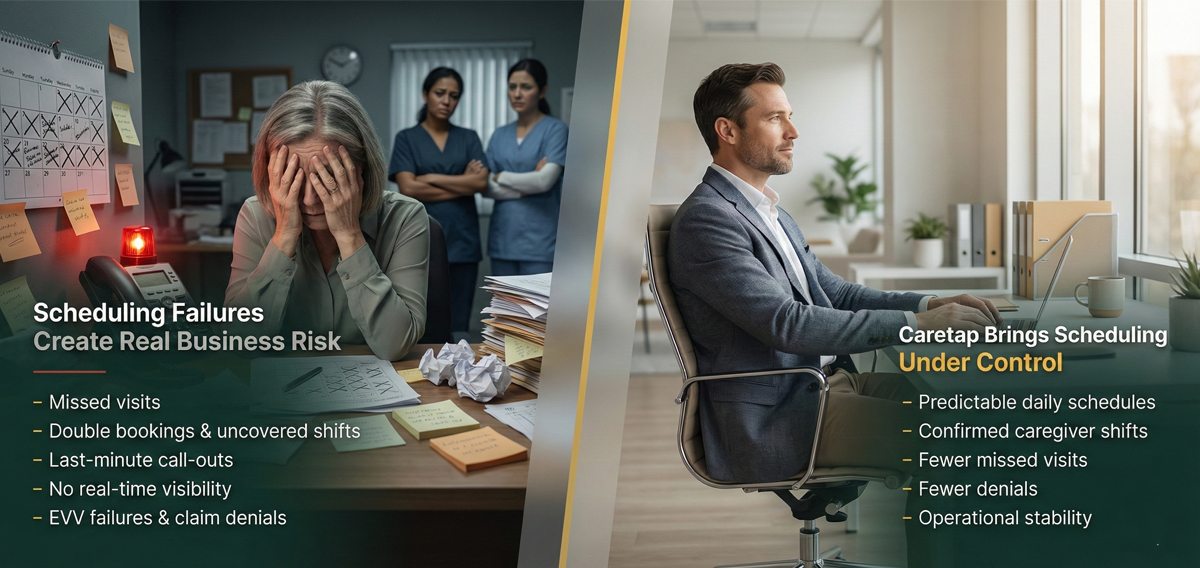
Scheduling is no longer just a job for the office. It helps keep patients safe, make sure the rules are followed, and protect revenue.
Common Scheduling Failures
- Manual scheduling errors
- Double bookings or uncovered shifts
- No real-time visibility into visit status
- Last-minute call-outs causing chaos
Why This Is Dangerous in 2026
A single missed visit can:
- Put the safety of patients at risk
- Break the terms of the contract
- Cause EVV failures
- Cause Medicaid claims are denied
- Damage to payer and referral relationships
How Caretap Fixes Scheduling at the System Level?
Caretap replaces reactive scheduling with a controlled, predictable workflow.
Mapped features include:
- Advanced Scheduling & Real-Time Alerts: Centralized schedules with instant notifications for missed or changed visits.
- 2-Way Caregiver Confirmations: Caregivers confirm shifts, reducing last-minute surprises.
- Live Visibility: Staff see what’s happening in the field without endless phone calls.
Caretap transforms scheduling from daily firefighting into operational stability.
One Missed Visit Can Cost You More Than You Think. See How Caretap Prevents It
3. EVV in 2026 Is a Hard Stop, Not a Billing Fix
Electronic Visit Verification (EVV) has matured and Medicaid systems now treat it as a gatekeeper, not a back-office correction.
EVV Pain Points Agencies Still Face
- “Visit Not Found” denials
- Caregivers forgetting to clock in/out
- Manual EVV edits triggering audits
- Technology failures in the fields
The 2026 Reality of EVV Compliance
- Medicaid validates EVV before paying claims
- Mismatched EVV data = automatic denials
- High edit rates increase audit risk
- Retroactive fixes no longer work
EVV accuracy must happen at the point of care, not weeks later.
How Caretap Ensures EVV Compliance
Caretap is built to eliminate EVV mismatches before they occur.
Key features include:
- 100% EVV Compliance System: Automatically checks the time, date, and place.
- Clock-Ins on Mobile and Landline Phones: Ensure rules are followed even when smartphones aren’t available.
- Signature Capture: Stops fraud and proves delivery.
In 2026, EVV success is measured by first-time accuracy, not rework.
4. Documentation & Compliance Gaps Are Silent Audit Triggers
Many agencies don’t realize they’re at risk until an audit letter arrives.
Common Mistakes in Documentation
- Paperwork slows down billing
- No signatures
- Care logs that aren’t always the same
- Reporting compliance by hand
What’s Changed in 2026
- Audits are more frequent
- Documentation gaps are no longer tolerated
- Payers expect audit-ready records at all times
Compliance can’t live in binders or spreadsheets anymore.
How Caretap Automates Compliance?
Caretap embeds compliance directly into daily workflows.
The following capabilities are mapped:
- No paper needed: Digital notes, signatures, and approvals.
- Auto-Tracked Supervisory Visits: Make sure that QP and compliance needs are met.
- Built-in reporting: Data that is ready for an audit without any work.
In 2026, compliance must happen automatically, not because staff remembers it.
5. Billing Delays and Denials Are Now a Cash Flow Threat

Margins in home care are thin and billing mistakes are expensive.
Billing Problems That Agencies Have
- Refusals for Medicaid and private pay
- Errors in manual billing
- Long cycles for getting money back
- Pressure on payroll while waiting for payments
Why This Is Dangerous
Even a small increase in denial rates can:
- Delay payroll
- Increase borrowing
- Force agencies to reduce services
Billing is no longer just about revenue, it’s about survival.
How Caretap Reduces Denials and Accelerates Cash Flow?
Caretap connects operations directly to billing.
Key features include:
- Automated Billing & Payroll: Clean data flows directly from EVV and documentation.
- One-Click Claims Submission: Reduces human error.
- Medicaid & Private Pay Automation: Faster reimbursement, fewer resubmissions.
In 2026, clean billing starts with clean operations.
Get Paid Faster. Stop Fighting Denials.
6. Fragmented Systems Are the Root Cause of Most Home Care Failures
It’s not usually just one thing that makes agencies have problems. It’s because systems don’t work together.
The Cost of Fragmentation
- Duplicate data entry
- Inconsistent records
- EVV mismatches
- Billing errors
- Compliance gaps
The 2026 Reality
Fragmented systems amplify risk. One missed data point can cascade into:
- Denials
- Audits
- Missed visits
- Caregiver frustration
The Caretap Difference
Caretap replaces fragmented tools with one unified platform for:
- Scheduling
- EVV
- Documentation
- Billing
- Payroll
- Communication
Agencies don’t need more software.
They need fewer systems that actually work together.
Conclusion: The Agencies That Survive 2026 Will Be Operationally Predictable
The strongest agencies in 2026 share one trait: predictability.
They experience:
- Fewer emergencies
- Fewer denials
- Fewer missed visits
- Stronger caregiver retention
- Stable cash flow
Caretap is more than just software for home care.
In 2026, it’s the operational backbone that agencies depend on to stay compliant, staffed, and financially stable.
FAQs: Home Care Agency Survival in 2026
What will be the hardest thing for home care agencies to do in 2026?
Operational risks, such as EVV denials, caregiver turnover, rule violations, and delayed payments.
What will EVV mean for Medicaid payments in 2026?
If EVV records don’t match visit data, claims are automatically denied. This makes it very important to clock in correctly.
How can agencies reduce caregiver turnover?
By improving scheduling stability, communication, and mobile accessibility for caregivers.
Why do home care claims get denied?
Is it better to have all-in-one home care software than several tools?
Yes. Integrated systems lower the risk of mistakes, make things easier for administrators, and lower the risk of not following the rules.
How does Caretap help people stick to the rules?
By automating documentation, EVV tracking, and reporting, Caretap keeps records ready for audits.